Posts

Banksy exhibit

This class continues to grow my appreciation for art, and as someone who does not care much for art I can confidentially say the Banksy exhibit is a must see. The art has such deep meaning, but always with a comical twist, in addition, the art has so many modern references such as, movies like Planet of the Apes and Pulp Fiction. Banksy is anti police, and anti capitalism, I noticed that he wants what’s best for the average person, his art is satirical to many elitists such as his mockery of Andy Warhol.

The first piece that stood out to me was the picture of an ape, with the text saying, “Laugh now, but one day we’ll be in charge.” This was easily my favorite piece especially because the Planet of the Apes series is my favorite movie series ever. I also belief this could be a reference to Darwinism and how apes will continue to evolve, and like in Planet of the Apes, will be in charge. Banksy had a few pieces with apes pictured as advanced beings, and this spoke volumes to how animals that humans used for entertainment, and hold captive may one day have the power to do the same to us.

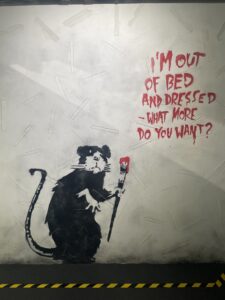
The next piece that stood out to me was the work of this rat, and there was many other rats pictured. Banksy being the rebellious type, appreciates the nature of rats and how they exist and no one likes them, also how rats are so little and harmless but hold such great power. Banksy is technically a wanted criminal. He has to be stubborn like a rat, so he can still make his art. He is not doing harm to anyone, yet people in power want him hunted, like a rat.

All in all, the Banksy exhibit is definitely my favorite museum of the few I’ve been to, Banksy is just an average guy, not like these artists who make millions and their art has little meaning, it is just sold for the value of the meaning, and he does not encourage his work to be sold as he is strongly against capitalism.

The Counter: Not Everybody Won’t Understand

Our class took a trip to the Roundabout Theatre to see a preview of a play called “The Counter.” The play features a barista, Katie, and an old customer, Paul, who begin interacting beyond coffee. Paul asks to be friends with Katie, which strikes me because I don’t believe you can be friends with somebody you don’t know much about. I can imagine that Katie was surprised as well. Paul understands the idea that you cannot be friends without revealing deep secrets about each other, so he starts to reveal that he is an alcoholic, and he becomes categorized as somebody who is depressed. Katie begins to open up about leaving her home, and her ex(friend?) to run away from the life she had when she had a hysterectomy. Paul and Katie begin to clash, as they both have different opinions about Katie running away. I enjoy the irony in this because while they have different opinions, they are not so different themselves.

Later, Paul asks Katie to kill him and surprise him. This is not explicitly mentioned, but I interpret it as Paul trying to run away from his issues by ending it, while he condemns Katie for running away. Katie does not want to deal with people’s pity of her having a hysterectomy while Paul does not want to deal with everybody else’s pity of him taking care of his mother and brother until they passed away. At this point in the play, I started to tear up, I felt as if I could sympathize with the characters even though the play is fictional. After much more talking, Katie’s problems seemed to follow her into her new home, as her ex-friend (who knows about the hysterectomy and hurts her emotionally) found her address and is going to see her. Paul tells her she has to go and move elsewhere to protect her peace. From once disagreeing with each other to understanding each other with talks over the countertop,  the moral of this is you cannot make assumptions that everybody doesn’t understand how you feel. People will never understand the full extent of how you feel. But they may understand the principle of the situation. Had Paul and Katie not given each other a chance, we probably wouldn’t have been met with the resolution of Katie and Paul both attempting to protect their peace in the end.

Art Lab

When I went to the Art Lab, the street leading right to the entrance was completely flooded, so I had to take a different route. It turned out that every other street after the entrance to the Art Lab was a one-way street going the opposite way, so I had to go down several blocks just to get in through the exit.

When I finally got there, the only class offered was for kindergarteners. Since I was already there, and I didn’t want to just go home without doing anything, I decided to take the class with them. When I walked into the classroom, they were all painting realistic people, but I am still stuck on doing stick figures, so it was embarrassing to see them doing much more advanced pictures. I ended up leaving the class and tried looking for another the same day, but the next class for people my age wasn’t for a few more days, so I would have had to leave and come back a completely different time.

I decided to stay longer and look at the paintings and sculptures that were on display. I also found out that there were many different classes offered. This included classes offered for painting, drawing, sowing, photography, darkroom photography, and stained glass painting. There were many different studios for each class, and many of the works produced there were on display.


“The Counter” – Suzanna Grigoryan

The Counter is a production that depicts the intricate relationship between two main characters, Paul and Katie. Paul is an old man who is a regular customer at the café in which Katie works. Prior to viewing the play, I felt dreadful because I am not a particular fan of live productions. Although I did not particularly enjoy watching this performance, I would not necessarily say that it was terrible. One of my immediate thoughts was that the actors undeniably performed very well. All three roles were capable of effectively embodying their assigned characters, however this factor was not enough to make the experience enjoyable for me. I personally felt significantly detached from a majority of the audience because I noticed that the popular spectating demographic consisted of elderly individuals, therefore I also found myself not understanding occasional phrases or what were supposed to be humorous remarks.

Nevertheless, I was ultimately able to identify multiple central themes of the piece. Originally, I believed that the message simply consisted of friendship, however throughout the show’s progression, new aspects were gradually introduced, culminating into various interpretations. Regarding the setup, I felt slightly confused by the timeline, as the switching of lighting was very frequent and sometimes I was not able to depict the significance of a seemingly new day. I would also notice that Katie and Paul often left the setting without speaking any words of farewell, which seemed strange, causing further confusion. Initially, Katie and Paul would conduct minimal conversation and I felt substantially disengaged due to the lack of dynamic qualities. What initially seemed like both characters merely sharing their life trauma soon turned into a deeper plot, exploring the importance of patience, second-chances, and taking risks. As the relationship between both individuals unfolds, they share personal flaws, providing the other with remedying advice without realizing the hipocricy within their statements. Katie admits her past failed relationships, revealing that she created a new life within the town she now lives in. Paul critiques her decision, claiming that she acted like a coward, running away from a minimal problem and forming an ironically false reality. Katie denies this personal attack, only to direct one of her own toward Paul when he spontaneously asks her to poison him. This transforms into a historical depth to Paul’s circumstances, as he persuades Katie to “surprise” him and in doing so, provide a shocking factor that has been absent from a majority of his life, causing feelings of depression, despair, and worthlessness. As the play progresses, both characters slowly help each other persevere through their individual struggles, ending with the unexpected return of Katie’s former friend. Not only does this provide Katie with an immediate resolution to face her old life again and start fresh, but it also provides Paul with what he has been looking for his entire life: a surprise.

In the end, both characters seemingly received their “happy endings”, although on an unfinished note, leaving the rest up to the interpretations of the audience. Some important lessons that may be deduced from this play may include the importance of recognizing human intricacy and that communication is vital within the need for mutual support and understanding. All people experience their unique encounters and the ability to confide in others without losing hope or determination is what defines the individual in continuing to live with optimism, strength, and hope, essentially self-same to Paul and Katie.

Snug Harbor Art Lab

Introduction:

My artistic ability when it comes to drawing, or painting is terrible. Unless I trace over some sort of already completed drawing, I can pretty much draw only well made stick figures and put random colors on a canvas. So, going into the art lab run by the Staten Island Museum, I expected to not really get how the art was drawn and find myself being lost in the room full of art. However Griselda, the person running the oil painting lab there, took us through a beginner crash course of oil paintings and was an amazing teacher as most of us were painting for the first time ever. I would say my experience at the art lab went better than expected as I created my first oil painting and learned a lot about how artists compose them.

Lecture & Painting:

Griselda told us the most challenging aspect of art is shaping the 2D world of a canvas into a 3D one. The artist has the responsibility of creating perspective within the canvas; the background having a lighter color to emphasize its presence and the foreground not overpowering the overall positioning of the art. She gave us a lot of useful tips such as starting with the background to make painting the foreground a lot easier, and also outlining our painting before even beginning. After her lecture on oil paintings, she set up everything to allow us to create our own paintings and we were given objects that we could choose from. I chose the fennel as the object since it was the most interesting to me, and I thought it seemed easy to draw. Just bits of splatters of green for the leaves and branches, and white for the base; however, it was a lot harder than I initially anticipated.

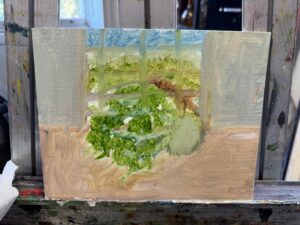
The funnel was placed within the perspective of a window and that’s what I imagined my painting to be. I wanted to have the window be within the perspective of the funnel and then have the funnel be the foreground of my painting. However, doing this as a beginner, was not a great idea. I started with the background of the clear sky, and the trees in the background, but then when I started painting the funnel it just blended in with my painting of the trees. So, within my painting you can’t really tell the difference between the foreground and the background and it just lost all perspective, which didn’t really turn out to be how I envisioned.


Picture of Funnel Painting

Conclusion:

It was fun to do my first oil painting at the art lab and it was therapeutic almost as I felt so relaxed after I finished my painting for some reason. It was also interesting to see how others painted the objects they chose; Aleksey’s and Kryistan’s paintings, in particular, did a really nice job of putting everything into perspective and you can clearly tell the objects they were attempting to paint. Looking back, my painting could’ve been a lot better if I just focused on painting the desk and the funnel, but what I pictured was the funnel getting a shining perspective from the window and the sky with the background having trees within it. So, I attempted to do so and although it didn’t come out as I expected, I definitely want to start painting more or just drawing in general. I used to draw a lot but I stopped, I think just before COVID so I want to start getting back into it again. Overall, it was a great experience and I learned a lot from Griselda and everyone there about oil painting, and it was great to sort of see the process for drawing the art and getting hands on with it.

The Counter Trip

Introduction:

My initial expectations of the counter were pretty high since I’ve been to broadway shows like spamalot in the past and they were amazing. Broadway shows have great acting, and really interesting stories so it’s always enjoyable to watch them. The counter was located in the roundabout theater and I had some worries about getting lost, but thankfully I didn’t miss the 1 train looking around wondering if I was at the right place (sorry Brendan.)

The Set:

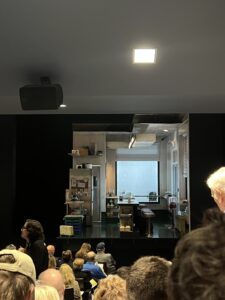
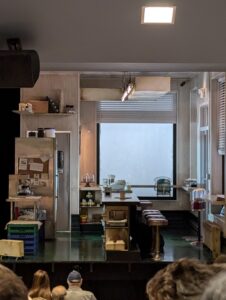
Unfortunately we weren’t allowed to take pictures during the play, but before it started I was able to take one picture of the set. It was an interesting set as it appeared to be a small diner with the windows fogged up to showcase the cold environment it took place in. You can always tell when a character was going into a scene by the shadow of their figure through that window. Apart from that I was surprised at how small the set actually was; however, looking back the miniature sized set played into the intimacy and perspective of the show and it was perfect since there weren’t that many members of the cast.

Picture of The Counter Set

The Characters:

In the cast, there weren’t a lot of background characters and people that don’t really add anything to the story. Every character that we were introduced to had a purpose to move the story along and it was refreshing not having to remember 20 different characters that don’t really serve a purpose into the main theme & story. The counter only starred Anthony Edwards as Paul, Susannah Flood as Katie, and Amy Warren as Peg. Paul was initially introduced as an alcoholic man who had trouble sleeping and seemed a little crazy, Katie just as the waitress with potential comedic relief, and Peg as the respected town Doctor. But, we learned about the specific intricacies of their relationships and stories later within the plot.

The Plot: 

During the start of the show, I actually thought it was really boring, but during the exposition it actually started to get pretty interesting. Paul had mentioned that he wanted to become friends with Katie and she reluctantly accepted his request. They shared their darkest secrets with each other: Paul wanted his death to be a surprise, so he bought poison from the dark web and gave it to Katie, asking her to put it in his drink one day. Katie, on the other hand, spoke about her “boyfriend,” who had left 26 voicemails, and revealed that she had moved away because of her hysterectomy. Their relationship had an interesting dynamic because of its evolution overtime. At first, they were just a waitress and a frequent customer conversing, but by the end it seemed like they had a need for each other. The one day Paul didn’t come Katie had actually been worried about him as her routine of talking to him each day she worked was broken, meaning that she actually started to care about him.

Conclusion/Final Thoughts: 

The ending was in my opinion terrible since it left off on a cliffhanger as Katie received another voicemail from her friend, where he mentioned that he had talked to her mother and moved closeby to meet her again, and Paul encouraged her to go to him as it wasn’t too late to take another chance at life. Paul and Katie said their final goodbyes and that was the end of the show. I realize I did leave a lot of details out like how Paul was in the peace corps, Paul saving a family from a fire, and how Paul had an affair with Peg, but I think the theme mainly revolved around Katie’s and Paul’s relationship so, I chose to sort of leave those out from the plot. Overall, I did end up enjoying the show, but it wasn’t really my type of show if I am being honest and the jokes they made were really dry, however the story was pretty interesting so it wasn’t the worst thing in the world.

Reflection of The Counter

     My trip to The Counter play at the Roundabout Theatre started with a fun bus ride with friends into the city. We talked about our expectations for the play, and we had some collected doubts about it. After hearing it was in its beginning stages, and that it was based on conversations amongst only two characters, I had premeditated my opinion that the play would be quite boring or not up my alley. After watching the play and finally giving it a chance, I was proved wrong. 

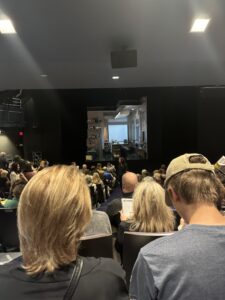
    Upon walking into the theater, I was shocked at how small and stagnant the stage was. Even during the play, the set did not change, so this was something I was not used to on a visual aspect. I actually quite enjoyed this, because I was able to focus on the story development rather than filler chaos happening in the background. Also, it felt like I was watching a vintage TV show; the stage was carefully oriented, almost 2-D appearing. Additionally, I was impressed with the unique storyline and the development of the plot and characters. The execution of the bond between two opposing characters of different genders, ages, and life experiences was impressive. The story taught me that no matter how different the people you meet in life are, they all have a background and are living life for the first time just as every other human is; human connection can go beyond having common interests. I especially loved the full circle resolution– Paul finally got a life surprise, not by death, but by forming a friendship with Katie. I found this ending cute and creative, a fun happy ending.

     Overall, The Counter was a beautiful story about life’s tributes and human connection and I enjoyed my time watching it and spending the day with peers!

My Insight to “The Counter” at the Roundabout Theater by Wilson Wu

       At first impressions when looking at the stage setup, I initially thought that the story would be a typical romance story of a man falling in love with a woman at a cafe counter. There was no reason to think of creating a story that mainly had two characters except for a love story, as there weren’t many side characters present to demonstrate other possible theater genres. I would later realize that the story is more than just a romance story, but rather follows the theme of friendship. This is an underrated genre that I feel many plays, TV shows, and movies don’t do a fantastic job of doing through their similar framework of friendship storytelling. When watching “The Counter”, however, I came to realize that my initial thinking of the play was entirely false.

       Despite not admitting to it, Paul had undergone many rough periods of his life after having broken up with his true love at high school, developing PTSD from his firefighter career, and even having seen his loved ones at their deathbeds being mistreated by the staff at their nursing homes. Katie experienced a different kind of suffering that involved imposter syndrome through failing to contact her once true love and undergoing many surgical procedures that had her uterus removed. Paul, however, managed to share these experiences amongst himself and Katie by saying aloud, “Let’s be friends! Yes, the type of friends that share their secrets and talk about experiences they would never share with anyone else.” As a person who had many friends who sympathized with me during my stressful challenges in high school, I thus heavily related to Paul and Katie’s friendship and grew very content when seeing their friendship developing into one that’s very important in sustaining each of their lives.

       The friendship bond didn’t form, however, until after a huge part of the story had unfolded. The beginning of the story felt very repetitive to me, as it was quite dialogue-heavy with Paul and Katie introducing themselves to one another and their lifestyles and interests. I strongly felt that the entire beginning could’ve been shortened to under a few minutes, as a play that has only 1 hour of screen time should be dedicated to plot development and landing the perfect ending that the audience could be satisfied with. Throughout the play, I laughed whenever Paul took his sweet time in wearing his heavy coat, carefully zipping it, and making a dramatic exit out of the cafe door. This is shown multiple times throughout the play, which illustrates an extreme repetition of events. Rather than having just that scene that spread no emotional impact to the audience, I think that the writers could’ve had Katie expressing her emotions of anger or sadness to the audience while cleaning up the Cafe in contrast to her leaving the scene in preparation for the upcoming one.

       The beginning portion did feel like a very important unfolding of events in reaching the climax. I was beginning to get hooked up in the play when Paul offered Katie a type of poison that he wanted her to use to end his life. At that moment I asked myself, “What kind of friendship is this?” Eventually, though, I’ll learn that Paul is offering that poison through his high trust in Katie in getting his final wish to live in surprise within the last few moments of his life. Katie was the person that Paul would want to have breakfast with before the final few moments of his life because of the sense of comfort and empathy that Katie had given him throughout the rough periods of his life. The interactions between Paul and Katie arguing on the morality of poison were very emotional to me, as it expressed to me how much they meant to each other especially when sharing lifelong secrets. This trust in itself is what makes friendships very important, as it emphasizes the respect and support that are essential for meaningful connections.

       At the end of the play when Katie got a voicemail from her ex-boyfriend in town, I almost shed tears when Paul jumped up and down in joy. The acting was top-notch and definitely impactful when having only two people discuss with one another their lifelong challenges. The silence between Paul and her ex-girlfriend was stunning, as I saw Paul’s expression of regret of not having spent his lifetime with his one true love. I wanted this acting to land a perfect ending, but instead left a cliffhanger that left many to question the events that would’ve happened. I’ve heard questions like, “Did Katie end up going back to date her old boyfriend?”, “Did Katie end up poisoning Paul that day?”, “Had Paul died shortly after Katie left the coffee shop?”. These lingering questions, in my opinion, shouldn’t be left out in any form of storytelling. This is because it emphasizes the lack of quality writing in closing the loose ends of the play to make the audience satisfied rather than craving any more events.

Time at the Roundabout

My experience began outside the Roundabout Theater, which looked old from the outside. When my class and I stepped into the building, we had to go to the basement to get to the theater. We then took our seats, and the play began. It started with two people, Kaite and Paul, in a diner. Kaite is the owner of the diner and serves Paul, a retired firefighter, coffee almost daily in the mornings. The play went on through their conversations and escalated when they decided to share their secrets. Katie revealed that she used to live in a different city but moved when her friend didn’t share her romantic feelings. Paul revealed that he feels his life is meaningless and wants Kaite to poison him. Upon hearing each other’s secrets, they were enraged and wanted to change the other person. The play went on and developed each other’s characters and shared their secrets. Finally, the play ended when Kaite’s friend arrived in town and asked to meet with her.
Overall, the play wasn’t horrible to see; many parts were interesting and funny, but after a while, their talking made me sleepy. I feel that the play needed more action or at least a change in scenery. The play only had three characters and one setting. If they had a larger crew or more settings, then the play would’ve been better; however, the play did well for their resources. Another thing that I disliked in this play is that it feels incomplete; the ending did not show if Kaite got together with her friend or what happened to Paul.

The Counter – Michael Gardella

The Counter is a play about a a waitress and a regular visitor in a local diner of a small town.  The unexpectedly become friends and he asks her for an unusual favor which reveals their deepest secrets.

Paul starts off each morning by going to a coffee shop. He would meet Katie and he was determined to become friends with her. He learned that she came from another city, but he assumed she left because of her old boyfriend. It turned out that she had 27 voice mails from him that she kept on her phone, and she wanted to go through each with Paul. As he continued his routine each day, they learned a lot about each other and became friends. He strangely asked Katie to pour a poison he got from the dark web into his drink when he was least expecting it. He said he wanted to go out on his own terms, but he also wanted it to be a surprise.
In addition to this, Katie found out that Paul was once an alcoholic, and Paul found out Katie had a hysterectomy. This was the main reason why Katie left, not just because of her boyfriend. Katie also found out that Paul had an affair with her doctor, Peg Bradley. After going through several of Katie’s boyfriend’s voicemails, a new one was discovered. Katie found out that her old boyfriend came to her town and wanted to see her. This surprised Paul, and then the play ended.

Katie spent the last two years trying to escape her reality. She moved to an isolated town because she got friend zoned by someone she kissed. Paul is different. He wants to have control of his life, which is why he wants to chose the way in which he goes out. He gave Katie the poison because he wants his death to be a surprise. He claims everything was straight forward, like the books he used to read where he could predict what would happen before it actually happens. However, the play ended with Katie deciding to go visit her old friend, which was a complete surprise to him.
I was confused about this ending. It seemed very sudden and I was under the impression that the play would end with Paul being poisoned. It can be inferred that he was poisoned that day, but the audience will never know for sure. Aside from this, I was impressed that the whole play was done by two characters and in the same setting. I also felt like some people in the audience were planted there to laugh at some of the jokes they made throughout the play, even though they weren’t really that funny.