Posts

My Experience With “The Counter

My experience surrounding The Counter play began long before I actually sat down in my seat to watch it and fully immerse myself in the performance. To elaborate as my peers and I discussed how we would get to the play we organized a bus trip and decided to travel together. Therefore, though the commute was over an hour and tedious, having my new friends with me made the trip not only tolerable but enjoyable in their presence. However, as we talked throughout the entire drive, we formed premonitions about the play and created inherent dissatisfaction and disappointment with the play prior to ever hearing an official synopsis of the play or giving the work a chance. Many of our concerns surrounded the fact that this play was off broadway, was not a musical, and had a slow and unentertaining story line.

I can now proudly admit that my preconceived notions of the play proven to be very wrong. Despite the fact that this play had one setting, their play on time and light transported us into their universe where through we were bound to a window into the characters’ lives set in the diner, we were able to connect and understand the characters’ fears and dreams. Additionally, in my opinion it was irrelevant to travel anywhere else as this is the only place the main characters interacted and grew their friendship. This diner, though seemingly simple and bland at first can be interpreted as so much more. it is symbolic for the characters’ newfound friendship, new beginnings, and a place of inspiration to face one’s fears and truly have the strength to live fully. Moreover, this diner perfectly captures the beauty of human nature.

Visit to see The Counter play

My typical impression of small productions like these is often negative, as I do not particularly enjoy simple works. I would prefer a play like a Broadway show because I like it when there is more going on since I get distracted less. The trip getting to the city wasn’t bad, just a lot of traffic which is to be expected.

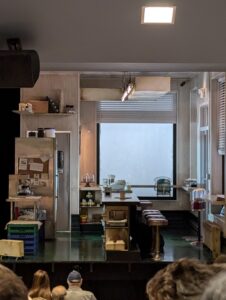
Walking into the theater, honestly,  I was underwhelmed because I was skeptical about how such a small set could remain the set for the entire play. Even looking at the audience, I was certain that it was meant for a different audience than myself. I thought to myself that it surely couldn’t be as static and boring as it seems, in some aspects, I was proven right and very wrong in others.

When the play began, we were introduced to the two main actors: Katie and Paul. Katie works at a diner where Paul is a frequent visitor, and throughout the play, the dynamics of their relationship reveal itself. For the first of the play, I was unimpressed because their interactions seemed very mundane and too ordinary to become interesting. Honestly, I did not like the play until Paul asked Katie to become friends, this puzzled me because with a person who you see almost every day, I would assume they are already beyond acquaintances. After Paul established the two were friends, he revealed a deep secret that he was rather bored and depressed with the life he had led, and in the future, he wants Katie to poison him. This struck me. Such an ordinary play suddenly turned into a complex dynamic between the characters, and this now put Katie at a loss.

After the poison came into play, it allowed for both characters to open up and tell each other’s secrets. At this point, it became so interesting since Katie revealed her past love life and that she had 27 voicemails she could never bring herself to delete. Paul helped her through it. The connection between these two made me see each of them in different lights; it revealed that neither of them had a person who could help them with these tough decisions, they didn’t have a best friend. It showed me how such simple interactions at a diner could be so much more meaningful. The fact that there were only two characters in the play was so more impactful as it shows the quiet nature of the town and how their connection is so simple yet complex. It is insane that this little town, little diner, and ordinary people left such a message.

The play addresses such serious issues in a lighthearted way as a way to spread awareness. When Katie revealed that she could not have kids, that really hit me. I even felt bad for judging the play so quickly, saying it would not have an impact on me. But that twist explained so much about Katie’s hard exterior and soft inside persona. It made me think that people that we meet daily have things going on that we do not know of. Ordinary people have something going on that never reaches the surface. No matter how well you think you know someone, they have an untold story. It is a lesson to be conscious that you can’t tell everything about a person by looking at them or small interactions. It was such a small thing that left a huge impact on me.

The only thing I must note is that many of the references were outdated, at least for me. This confirmed my prediction it was aimed at an older audience. The one thing I liked was the connection to sharing the Netflix password it provided a humor that was easy to understand. However, even with the play geared toward an older audience, the message was still clear.

The use of lights and audio was something that was worthy to note as it added an element of movement in an otherwise static play. It was interesting that the progression of time was still easy to understand despite no direction. The simple light movement was crucial for supporting the play’s message.

The ending of the play was what I loved most about the play. The open-ended play posed so many questions: Did Katie poison him? Did Katie reunite with her old love? Did Paul continue his life in the town or move? It was such a meaningful ending. I loved the evolution of both characters, which was most seen at the end of the play. Katie is now able to open up just a little more and is able to rekindle her love with her past. Paul now sees the complexity of life, and how it is not always running away but simply moving forward, I hope he moves out of the town that he has stayed in most of his life.


Banksy Museum Visit – Amanda Alencastro

On Saturday, 9/21, I made a trip to Manhattan to visit the Banksy Museum. I had ordered my ticket online prior to arriving, which was convenient. However, I do not think I would have had to wait very long to purchase a ticket in person because there was no line, and there were only a few people in the museum at the time. These people were different from one another, some were younger couples, some were older, and there were a few small families walking around. I thought it was interesting that Banksy’s art attracted various different demographics.

Attempting to ignore the amount of pieces that were displayed on artificial walls (to me, this felt disingenuous), the images themselves were quite intriguing to me.

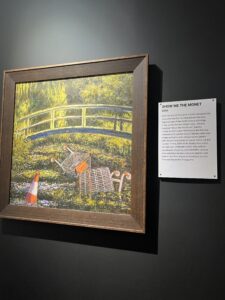
  1. Show Me The Monet, 2005

This piece stood out to me because I remember seeing original Monet works at the MoMA when I visited for this class. This modern take on the piece in which Banksy adds items such as shopping carts and traffic cones to the landscape. These items look out of place in the context of the piece, which seems to be intentional. I think that this can be interpreted as commentary on the rise of the capitalistic nature of the world, as shopping carts are essentially polluting this image of a natural environment. The parody-like disposition of this painting is exemplary of a common theme among Banksy’s art, which is that it goes against the anticipated. He uses his craft to call out issues in the world that he deems important to spread awareness about. This can be considered a sign of non-conformity, which is both prominent in his ideology and his art.

2. Game Changer, 2020

This piece piqued my interest due to its meaning. This art is a tribute to healthcare workers, aligning them with figures of superheroes. While this can be considered a general sentiment, in context it is more meaningful when the year it was made is taken into consideration. This work appeared in 2020, amid the peak of the global pandemic. Nurses and healthcare workers were risking their lives to treat others and worked to minimize the spread of the virus. Creating this work dedicated to the sometimes unacknowledged challenges that these workers faced signifies how Banksy not only uses his abilities to draw attention to negative aspects of the world that need attention, but also utilities his art to uplift the under-appreciated.

3. Festival (Destroy Capitalism), 2006

The message of this piece continues to affirm the anti-capitalist beliefs that are conveyed in other art that Banksy has created. However, the metaphor of a merchandise stand stood out to me because when I reached the end of the museum, I was led into a gift shop. I found various different items bearing images of Banksy’s most famous and popular pieces, all available to purchase. I am aware that this museum is unaffiliated with him, but it provokes me to wonder why he would not stop the operation. I believe this may have been intentional to give further meaning to pieces such as this one, as even Banksy’s most anti-capitalist works have been commodified in some shape or form by this museum. Whether they are merely being displayed, or they are literally being sold in the gift shop, they are being commercialized. This solidifies the idea that capitalism is still on the rise and that this is a current matter.

In conclusion, the Banksy museum allowed me to explore the various topics that Banksy used his art to discuss and raise awareness of, but its existence may be built upon irony.

The Counter

The day before, I looked up information about the play and learned it was a new work, so I decided to keep an open mind. While researching, I found out that there would be no intermissions. This wasn’t a problem, but it was definitely a change from what I was used to seeing in the couple of Broadway plays I had attended before. After work, I headed to the ferry and, although I was almost late, I managed to catch the 1:30 ferry.

When we finally arrived at the Roundabout, I didn’t know what to expect from the play. The set was simple yet extremely detailed, and although it was static, the use of lighting created a sense of movement. The play centered around a man named Paul, who comes to the same diner every day, and a woman named Katie, who runs the diner. Paul slowly reveals to Katie that he is depressed and that his world has become mundane. He tries to use Katie as a source of “entertainment” by learning why she moved to this place and how her life became so “boring.”

He discovers that Katie ran away from her past, moving from the big city to this small town in an attempt to escape. The person she tried to escape was a guy named Gil, a friend with whom she had developed romantic tension. When she decided to kiss him, thinking it was the right thing to do, she was met with a reaction she hadn’t hoped for. Instead of facing the consequences, she ran away.

On the flip side of the story, Paul tries to get Katie to open up by divulging details about his own life and how he ended up in the diner. He begins by telling her that he is depressed and tired of how predictable the world has become. To create a surprise, he offers her a bottle of poison, stating that he wishes to be “poisoned” by her as a final surprise. At first, Katie protests and tries to come up with different solutions, which temporarily keeps the problem at bay.

As the play unfolds, Paul continues to share more about his life, revealing the loss of his brother and mother. This clearly serves to illustrate why Paul is so jaded toward life, highlighting the significant grief he has endured.

The climax of the story occurs when Paul becomes upset with Katie for prolonging his death, feeling that she has no idea what he has been through. In an effort to calm him down, Katie reveals that she had a hysterectomy, and on the day of the procedure, she felt a part of herself die. She shares that the only two people who know about this are Paul and Gil. This revelation allows Paul to better understand Katie’s situation, and the scene concludes with a silent hug, accompanied by an unspoken promise from Katie to end Paul’s life the next day.

When the next day arrives, Katie receives a call from Gil, who is in the area and asks if she’s free to meet. Hesitant, Katie realizes that the right thing to do is to reconnect with him and attempt to restart her old life. Paul fully supports her decision and decides to take over the diner in her absence. The play ends on an ambiguous note, with Paul staring at his untouched coffee, which may or may not be poisoned.

The play, though slow at times, builds beautifully toward the finale, with the tension between Paul and Katie escalating until it culminates in a single scene. Everything feels genuine; these are two people with very different outlooks on life trying to find common ground. Paul, much more jaded, views every experience as the same and believes that the only surprise he is missing is death. In contrast, Katie is comfortable with the mundaneness of her life, fearful of opening herself up to new possibilities and confronting her past.

Through their interactions, both characters evolve. Katie seizes the opportunity to revisit her past and attempt to right the wrongs she once made, while Paul is surprised to learn that Gil, rather than abandoning her, had spent two years trying to find her. This revelation surprises Paul so much that he hesitates to drink the poisoned coffee at the end, beginning to realize that maybe there is more to life than he initially thought.

My Thoughts on The Counter

Before seeing The Counter I had low expectations because I found most of the plays I have seen throughout my life boring. On the day of the show, I was surprised it was located in Times Square, and when I arrived there, the building was a lot smaller than I thought it would be. When I entered the theater, there were a lot of people in the audience and a small, empty set of a coffee shop, which lowered my expectations even more. 

Despite all this doubt, after finishing the show, I was shocked as to how good it was. Basically, it depicted a conversation between Katie, the owner of the coffee shop, and Paul, an old man who goes to the coffee shop every morning from Monday to Saturday, and I loved the window effect when Paul was walking past it every day. It did a great job in showing the freezing cold temperatures outside and the cozy warm atmosphere inside the shop. The play also did a great job in characterization. They did great in making the audience feel bad for both characters, especially Paul. There were these moments where all the lighting was focused on one character as they were speaking while they were sharing depressing statements. The one scene that really got me on the verge of tears was when Paul gave Katie a poison he bought from the dark web, and told her to surprise him by putting it in his coffee one day. The rest of the play was spent with Katie trying to cheer Paul up, and the play ended with a great cliffhanger that made me eager to know what will happen next. One more thing that I found cool was that I found out the actor Paul was Anthony Edwards, and he had an appearance in the Top Gun movies. Overall, what I took away from this play was that there is value in life no matter how you perceive it.

Trip to see The Counter

I had never heard of The Counter before this trip. The only hint we were given regarding its plot was an advertisement outside of The Roundabout Theatre with the quote: “IT WAS AN ORDINARY DAY UNTIL IT WASN’T.” Upon receiving the playbill I was even more confused. There were only four characters in the cast, one of which doesn’t even appear onstage, and only one setting. The stage itself looked like an IKEA display kitchen (second time drawing a comparison to IKEA in my blog). 

One thing I also noticed immediately after sitting down in the auditorium was the age of the other audience members; most of them were much older than us, so I began to wonder how this play might attract such an audience. 

The play started off pretty slow. The main characters Katie and Paul were cracking jokes, so I was put under the impression that maybe it was a comedy. As the show progressed, I kept wondering when the ‘turn’ was supposed to happen; when did it stop being “an ordinary day”? Even in hindsight I can’t seem to figure out where exactly the turn happened. Was it when Paul asked Katie if they could become closer friends? Or when Paul asked Katie to poison him? Or when Katie received a new voicemail? 

I really enjoyed the way the script was able to convey both Katie and Paul’s development as they learned from each other. They discussed the reality of depression and its impact on relationships, which are seldom mentioned, especially in relation to the older generation. It was this theme that made me realize why the audience was older. However, while the topics discussed in the show seemed to target an older audience, I found Paul’s fear of ending up in the same nursing home as his mom and brother to be very relevant to me since my family has a history of Alzheimer’s disease. In its later stages, individuals essentially require around the clock care, so nursing homes become an unfortunate reality.

Most of all, I really liked the way that the set was designed to use lighting as part of telling the story. The overhead lights fading to black represent the cycle of day and night. This notifies the audience of a change in scene when the whole play is set in one place. The separation of scenes is especially important in this case because the director intends to convey that Paul and Katie’s development happens over the course of many days. Additionally, the golden light cast through the frosted window in the diner indicates to the audience that Paul is always there unusually early, supporting the mentions of his insomnia. I admire how the frost on the window serves multiple purposes. It both obscures the view of backstage, and provides a strong visual of this wintery upstate New York setting, where characters come into the diner shivering in heavy coats.

The Counter Review

The Counter was severely underestimated initially, but I left with a new point of view about the expected vs. unexpected of life. One of the main points throughout the play was that Paul, the lead male role, wanted to experience a surprise in his life because he was too numb and comfortable with the life he has been living. The emotional and physical exhaustion he was left with after taking care of and losing his mother and brother had become unbearable. After experiencing so much grief, Paul’s life became predictable and he wanted to gain back at least an ounce of control. To him, the solution was a radical approach, specifically deciding the way he would die but not when he would go. He transferred partial control to Katie, the female lead role, to gain the surprise element he was missing in life. As a result, the audience was left in suspense, wondering when she would add the poison to the coffee and if she would even do it.

While Paul was playing with his life and letting it hang in someone else’s hands, Katie was frantically going through the motions of her so-called “give up life” or escape fantasy. On the surface, she appeared satisfied with her quaint little life working as a diner waitress in a small town. Deep down, she was nitpicking month-old voicemails and contemplating if her past actions justified the life she has now. She was pulled into quite a situation when she agreed to be friends with Paul and share secrets or tough talks. Little did she know that Paul would be criticizing her life and implying that she was not familiar with the concept of having to take care of someone. The immediate level of aggression from Katie’s voice shocked the audience. Her explanation of her obstacles, such as having to give up the option of children, indicated that she knows what it means to be selfish if it means taking care of yourself.

The repetition of the counter scene emphasized that having the same daily routine could provide a sense of balance, but it could also become mundane. Every morning, Paul would come into the diner and Katie would pour him a cup of coffee. This interaction is what opens the door to the friendship that they develop throughout the play. Had it not been for those tough talks, Paul might have never started to learn Italian and Katie would not have deleted any voicemails. Both characters would have missed out on what the world was offering them, and they needed that extra nudge out the door to remind them that there is a meaning to life and it becomes much warmer when surrounded by friends. 

The Counter play experience

Brendan Kwan 

23 September, 2024

My day started off with me eating a small, modest breakfast sandwich. I brushed my teeth, got dressed, and went to the ferry. I met up with my friends at Empire Outlets and we took the ferry with our other classmates. When we arrived in Manhattan, I second guessed myself and missed the train with everybody in it, prompting me to take the next train that came around five minutes after. When I got off the train, I attempted to use Google Maps to get to the theater, but it caused me to run for twenty minutes in the wrong direction. I then asked a kind gentleman for directions and he told me where to go and I finally arrived at the theater after fifteen strenuous minutes. The play consisted of 2 main characters: Paul and Katie. Katie was a waitress and Paul was an ex-alcoholic. Paul talks about his obsession with Sophia Loren and Italian tape recordings. Paul wanted Katie to poison him. Katie did not want to poison him, because she would go to jail for murder. Both characters went through tough times, Paul being an ex-alcoholic and Katie moving and dodging twenty seven voicemail messages. They hugged and she went to find her mystery voicemail man. The play was pretty good, but to be honest, it did not feel short at all. The seconds felt like minutes and the minutes felt like hours, but I think that was partially due to the fact that I tired myself out while trying to get to the theater. Overall, I really liked the set of the play and it was a great first play to watch.

Art Lab Aleksey

     My trip began when I arrived at Snug Harbor. The layout of the park was confusing, but I managed to find the Art Lab building. When I entered, I was greeted and given a free rubber wrist band and a sheet of paper that depicted what activities were located in what room. I decided to go to the oil painting lab, since I have never tried it. When I entered the room, I was greeted by an art teacher and my peers. The class began with the art teacher showing some of her works made with oil paint, they seemed beautiful and the thought of soon making something similar made me excited. The art teacher continued by setting up the classroom with chairs, easels, and art models. After that the class was handed a canvas, a plastic cup with a paint dissolving solution in it, a paintbrush, a wooden board with paper on it, and paper towels. Then I had a choice of what to paint and I chose a pair of pears on a dark red background. I set up my equipment near the pear model station and chose the oil paints that I need. 

     I began painting the pears by drawing an outline of the pear shapes with a light-blue paint. In order to do this, I needed to dip my brush into the paint dissolving solution then the light-blue oil paint. Then I began mixing colors to match the color of the first pear, which was a brownish-green, a yellowish-green, and a light-green color. After a couple of attempts, I finally made the desired colors and colored inside and a bit over the light-blue outline. Then I moved onto the next pear, which had a yellow-brown and yellow-green color, and colored in the outline. After fully coloring the pears, I went on to create the color of the background, which took me a while to replicate it accurately, and colored it in. With the main details of the painting done, I went on to create the shadows, which was just a darker version of the original color. Finally, I created the stems of the pears and finished. The teacher told me that the painting will take a week to dry and to keep dust off of it. I took my artwork and went home. 


The Counter

For my first experience with professional live theater, I would definitely say that I enjoyed The Counter. The play followed Paul, an aging retired firefighter (played by Anthony Edwards, who I totally did not expect to see after knowing him only from NBC’s ER) and Katie, a waitress at the diner Paul frequents. Initially, I found their banter amusing, as it almost reminded me of my own job. I work in a bakery, and I periodically get customers who love to tell me their life stories all while I’m ringing them up or helping them choose a cake for whatever occasion. Paul and Katie’s friendship steadily deepens as the play progresses, only for Paul to ask of Katie the unthinkable. One day, he gives her a vial of poison he had purchased online and tells her to put it in his coffee without telling him when, so that he can be “surprised”. Understandably appalled, Katie sees to it that Paul does not fall into any deeper of a depression that he seems to be in and does everything in her power to keep Paul alive. A theme of the play I found to be especially compelling was that of dying on one’s own terms. Paul’s brother had died in a feeble state, weakened by disease–something Paul absolutely does not want for himself. Although his purported method of achieving such a thing is morally questionable at best, I nonetheless respect that he simply wished to die on his own terms.
An aspect I highly respected about Katie’s character was her self-assurance in regards to why she left the city in the first place. Paul jabbed at her, saying her moving was a “give-up life”: for Katie, however, it was anything but. In actuality, it was her new beginning after a traumatic hysterectomy due to endometriosis. The scene where she finally tells Paul off and explains why exactly she moved was, for me, one of the most satisfying in the entire production.
Beyond that, I found their friendship beautiful. Paul and Katie genuinely supported and uplifted each other throughout the play: Katie continually pushed Paul to stay alive, whether that be through learning Italian or pursuing an old relationship with Dr. Bradley, and Paul was a support to Katie in navigating her feelings for a friend who had rejected her. Ultimately, Katie decides to go meet this friend on Paul’s urging, and the two share an embrace before she leaves and Paul is again left alone. I admired Paul’s selflessness in this moment: someone as lonely as himself could very well have told Katie to stay at the diner so he could have his conversation partner, but he only ever had her best interests in mind, just as she did his. The Counter, to me, serves as a testament to the profound strength of friendships forged in unlikely places.