Posts

The Counter

The Counter is the first ever show I have been to, and to be frank, I walked in there with the expectation of it will be boring and I won’t really care or be affected by the show. I ended up being entirely wrong, I actually really enjoyed the show and was amazed how the director was able send such a strong message using just one set and only 3 actors.

The simplicity of the coffee shop was perfect fitting for the simplicity of Katy. She says how she is content with having a front porch, watching Netflix, and going on walks. However, at the end she ends up opening up the truth of what she really wants in life, but does her inability to have kids due to getting her ovaries taken out is holding her back, and keeping her in a shell. After she opens up to Paul, she ends up getting over her issue, maybe not completely, but over it enough to go talk to her ex situationship.

Paul is an extremely troubled character who at first seemed like a simple man, who just enjoys his morning coffee, but eventually opens up to Katy expressing how miserable in life is, and how every day he is living such a boring life and already knows what happens. He does not state he is depressed, but he says that he wants to die at a random time within the next 2 months so he will be taken by surprised when he dies. This is clearly a sign of depression, but he claims he is not depressed and does not need help. Paul ends up showing some positive signs of his mental health towards the end as he gets excited when he sees such an impact he’d had on Katy and how she surprised him by going to hangout with her ex.

The relationship between Katy and Paul starts off rocky, as Katy is a bit weary about it and is reluctant to say yes to telling secrets and giving each other tough talks, but these tough talks end up saving each other as the tough talks got Katy to hangout with her ex and got Paul to rekindle his relationship with the doctor. This show portrays the beauty of friendship and how important it is to have a friend to talk to and it will be life changing.

All in all, my first experience with a show was very present and I hope to see one again soon, maybe a bigger show with more sets and actors.

Art Lab and The Creative Limits of Photorealistic Art

Art Lab felt like a blend of different junctures on my art appreciation journey. On one level, it was a regression to a bygone experience of art in my life. My friends and I were in an oil painting class with an instructor, trying our best to mimic the scene in front of us. This recalled my childhood experience of art as the exercise of a skill: developing a technical ability to mimic reality on a canvas. On the other hand, I gained thematic value from observing some of the art pieces which lined the walls, which is how I conceive of art’s value today. 


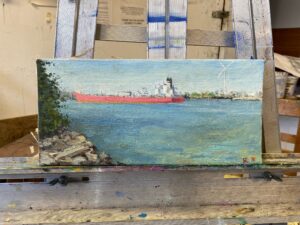
First, I spent my time in an oil painting class. The instructor, an artist herself, explained the process behind her realistic art. She starts abstractly and gradually attempts to replicate real world sights. These include apples and views from Staten Island.


My impression of the overall style of her works is that realism feels antiquated. I gain nothing exceptional from these images of fruit and a boat that a photograph couldn’t have communicated in the same way. That is not to say that a realistic painting has no value. However, a realistic painting does not provide any substantial unique value in terms of the medium itself. Realist art is impressive as far as the mechanics. A person is accomplishing what only a camera can do. However, creativity is limited in the painting process because the artist feels no need to communicate a message. In the same way that abstract expressionists rely on obscurity in lieu of a message, contemporary realist painters rely on their expertise. Their work is based on the notion that they don’t need to do the difficult work of revealing some theme of value because they can stand on their own competency. The vapidness of realism was confirmed by my own experience of actually performing oil painting.


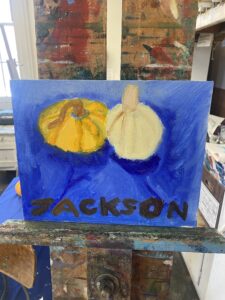
I chose to paint pumpkins.

Initially, I believed that I would try to convey a message. I thought that the variation in the sizes of the pumpkins coupled with their closeness would convey that diverse things can meld well together. This kind of intentionality is artistic. It is the same reason why a photographer is an artist; they choose the subject and how to frame it. However, as soon as I began painting, my higher-order artistic thinking went out the window. All that was on my mind was how to produce the most accurate paint colors, paint the shadows and display all of the pertinent marks of the pumpkins. The artistry ceased once the shot was chosen and thus the resemblance to photography ended. That is because the goal of my realist art was to put my mental image on paper, unclouded by themes or emotions. The entire exercise felt juvenile, hearkening back to a time when the best artist in the class was the person who was most adept at using the medium. I feel like my view of “good art” has matured since that time. It is no longer based on adroitness in wetting the brush just enough to produce aesthetically pleasing strokes. Instead, it is found in the imagination which went into the piece, whether that was the thought behind what subjects to depict or how to depict them. One could argue that when one nails down the technical skills enough, one has the room to add in inventiveness. Professional artists are likely concerned with the message of their work no matter the genre. However, if the art is photorealistic, then there is no original thought beyond the initial framing phase. A painter of realism is best served by being as machine-like as possible.


Due to the emptiness of realism, my favorite part of my finished painting is my name. That part feels personal and infused with authentic thought unlike the remainder of the work.


The art on the walls of the Art Lab reminded me of where I find the substance in art.

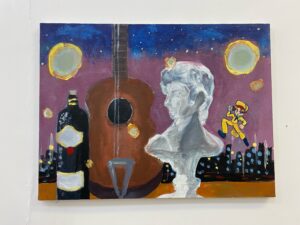
First, this painting resonated with me because it has the elements which realism is missing. Through its manipulation of the size of objects, it conveys relative significance. That the sculpture, guitar and bottle of wine tower over the city exhibits that the arts and the bars are what the artist finds beloved in urban life. The relative size also relays the primacy of the individual. Rather than the collective force of the city, the objects which matter to a specific individual are given visual priority. Additionally, the purple colored sky conveys tranquility. The artist is communicating that they find immense solace in the highlighted aspects of their life.


Second, where I can appreciate realism is in the above painting, which also graced the Art Lab walls. The artistic value is found in the setting choice. In fact, this image would make for a photograph which is just as beautiful. The painting depicts an object of possession in a way Berger would have despised, but I find it quite charming. The image embodies the success of retirement. The caption ought to be: a person sighs with satisfaction and takes one last look from the dock at their boat after a long day of wading through the sea. What is picturesque is not even so much the sunset, but that the sunset feels like it is a merited reward. The spectator is placed in the shoes of a person who has earned the luxuries of island life after years of material acquisition. The sun is setting on one’s life and yet, this painting captures that one still has many moments left to relish in one’s own greatness. I don’t look forward to aging, but this painting makes me question whether I should. One dreams of coming to a point in life where one can just bask in all their accomplishments. There is nothing which says wallowing in one’s own success like buying a boat, which fulfills no practical need other than that very human impulse for delighting in one’s own preeminence.


The Counter is About Why We All Need Friends

The Counter does a fantastic job of posing friendship as the answer to the question of why live. The world is lonely, tragic and even boring, but friendship is life-affirming and agentic.

First, The Counter centers the viewer in a familiar setting to our own. Although in a rural town that differs from Staten Island’s suburban atmosphere, it is also an atomized world. Katie watches Netflix and goes on walks on her own. Life’s highlights are the movies and the grand opening of the new Whole Foods. The best part of Paul’s day is his conversation with the woman who serves him his morning coffee before a deep relationship even develops between them. It is telling that the characters are so removed from social institutions that their close relationships are with those who facilitate their consumption. That is because too often in the modern world, one’s identity is not built by human connection but by isolated consumption, whether of films or morning coffee. One might share their streaming site passwords with others, but the streaming itself is a secluded endeavor. It is simply not possible to share consumption, and so life remains solitary.

Friendship offers something substantive to share: one’s life. A true friend is the kind Paul describes towards the beginning of the play. A friend is a person who can be relied on and who can help one deal with life’s problems. This cliche definition is revealed to have tremendous utility in explaining the value of friendship. As Paul and Katie share their secrets with each other like some kind of teenage party game, they end up becoming each other’s backbones in their respective struggles trying to escape their lives. Paul had judged Katie for leaving her city life behind and Katie Paul’s adultery and suicidal ideation. However, they came to empathize with one another and comprehend why they each felt so desperate for an escape hatch. Furthermore, the play demonstrates that sharing lives involves not merely sympathetic spectating, but actively participating in each other’s lives. For instance, Katie encourages Paul to learn Italian and pursue his forbidden love. Additionally, the revelation of Katie’s hysterectomy pulls Paul off the edge because each was a stakeholder in the story of the other. However, the unparalleled instance which profoundly conveys that friendship entails being contributors to one another’s lives is when an exhilarated Paul pushes Katie to reunite with the guy who friendzoned her. He grabs her by the shoulders and effectively wills her out of the door of the cafe to go meet him. Katie trusts Paul because he has become her pillar, just as she has become his. The play’s ending thus imparts that the friendship bond-the sharing of a life-is not only one of mutual confidants and advisors, but active partners who help one another be the best versions of themselves.

Second, friendship is posited as a remedy for life’s tragic nature. The Counter claims life is tragic because of its inevitable calamities. This is indicated by Paul’s description of the powerlessness he feels in fending off aging and the grief which remains from the deaths of his close family members. As a result of this grim perspective, Paul views control over his own death as the only area where he can exert some measure of autonomy. In correspondence with this, Katie found herself paralyzed, in her case by illness and unforeseeable relationship issues. She seeks to control her own destiny by exercising her freedom to escape. Escape is conceived of as the one choice people are left with during an unmanageable catastrophe. Yet, escape is an anti-social choice. It is clear how that is true of suicide. The extreme ghosting Katie engages in-the moving seven hours away kind of ghosting-is also an attempt to break loose from social connection. Although she is fleeing the discomfort that comes with being friendzoned, a fundamental part of relationships is that they don’t always turn out how one expects.There is another person involved after all. Thus, Katie’s ghosting is an escape from discomfiture which is intrinsic to mutual social connection. 

As opposed to escape’s disengagement from others, friendship rectifies a part of life’s pains in one simple sense because it provides a shoulder to cry on. Paul details how he is tired of hearing shallow remarks of comfort as he walks in the street. He despises Peg’s pity. Pity is the surface-level sadness one expresses at the misfortune of another. True friendship means empathy, which is suffering with another person-not expressing heartache at another’s pain in a way which makes them feel inferior. For instance, a friend’s empathy is how Katie divulges her secret illness history. She displays that she feels compelled enough by the pain of Paul’s story to share her own with him.

A second more complex way that friendship resolves the inherent tragedy of life is that it provides a measure of dignity. Paul hates pity because it robs him of his self-respect. Friendship not only provides compassion which doesn’t demean a person, but is a mechanism for autonomy, which produces pride. Unlike the great careers and life partners Paul had waited for, Paul consciously chooses to open himself up and court the friendship of Katie. He makes a move at the counter and admits he isn’t happy being an acquaintance. Friendship cannot be accomplished by idleness. It requires people to break the ice and continually reinvest their energy into caring about one another. A true friendship is something which requires taking responsibility and making a continuous commitment to prioritize the relationship. Paul is a little shocked that Katie is upset about his being sick for a day. However, he shouldn’t be. She is his friend and in being such, had taken on the mantle of overseeing his well-being. One lesson of Paul and Katie’s relationship is that the fundamental ennobling choice of one’s life is whether one takes a deep interest in the lives of the people around them. 

Third, The Counter asserts that friendship infuses life with novelty. This is because people get bored of themselves. On one occasion, Paul laments that he has gotten the gist of life’s monotonous routine. On another, he says that if he doesn’t sleep, he just talks to himself for hours. Arguably, Paul finds life dull because nearly all of his life is spent talking to himself. His life is only kept stimulating because he has another person in Katie-whose mind he does not have access to-with whom to share his thoughts. Even Paul’s hobby of learning Italian is intrinsically communicative. Since he is not going to Italy, the value he gains from the pastime comes from speaking to Katie in Italian. 

Friendship is gripping because there is usually always something to learn about one’s friend. Even when one thinks they have learned it all, built-in to human relations is that two minds cannot see each other’s thoughts. As long as there is no telepathy, human beings will be forced to face one unknown, which is the other. The whole reason why Paul and Katie-why any human beings for that matter-can have a back and forth dialogue where they have “fights” and not gauge each other’s responses is because they are of separate minds. This trait gives friendships dynamism, which comes with both instability and innovation. Paul is looking for “surprise” which is why he would like Katie to decide when to kill him. He can’t access the thought process of a friend and as a result, Katie being given discretion means he wouldn’t know when his death is coming. Paul was banking on the precariousness of friendship. Sometimes people freak out and overreact to things. If Katie were to kill him, it would be because she had lost her mind. As Paul says, people do that on occasion. Instead, Paul discovers that friendship can produce an optimistic form of surprise-the unexpected progress of a friend. At the end of the play, Katie’s situationship comes to meet her in town. Paul is enlivened by the new developments in her relationship and the potential for her to not only connect with a great guy but repair what has broken her for years. Katie declares this series of events the “surprise” Paul had been looking for. That is because friendship brings constant newness. Friendship provides the potential for one’s companion to unpredictably alter their circumstances and thought processes. Personal change is premeditated, but constructive change in a friend’s life is something one only catches glimpses of when it is shared with them. Paul got in on the ground floor of bettering a friend’s life, which is the exact kind of new modulation he ached for.

One could come away from The Counter feeling depressed. The play explores the idea that all people are in a sense waiting for the aging process and death to rob them of everything they ever had or loved. In fact, it is helpful to conceive of life as waiting in a waiting room. There is nothing more soulless than that. One may skim through magazines, but they provide nothing of substance. Additionally, the strangers one sits across from may curl their lips into a semi-smile for a moment but they will immediately retreat into their own distant world. To top it all off, one is impotent in speeding up what feels like an endless process. The Counter asks one to imagine that a close friend has walked into this waiting room. The atmosphere changes completely. In addition to fixing the loneliness of not having someone to delay life with, the presence of a buddy actually ends the eventless interlude. First, speaking with a friend ends the tyranny of the staff who usher in the next appointment. One partakes actively in friendship rather than being idle and letting the outside world dictate one’s “waiting room” experience. This agency is paramount to a joyful life. Additionally, whereas one had lacked spirit, one gains seemingly limitless energy. This is because a person is no longer imprisoned with their own thoughts. Instead, one has surprises at their fingertips in the form of hearing about their friend’s experiences and living through this new experience together. This is how a single friend can transform the gray paint on the walls of the doctor’s office waiting room into a vibrant rainbow. The Counter expresses that friendship makes life worth living because it stops the lonely, feebling and insipid waiting in its tracks. Katie was Paul’s waitress. By the end of the show, she is his friend.

Art Lab

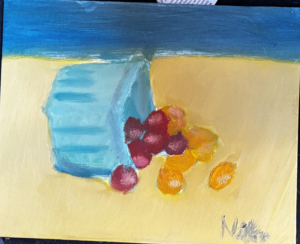
I went to Art Lab at Snug Harbor with a couple of my friends. I think this made the class more enjoyable. It was my first time oil painting, and it was definitely the most difficult medium I have ever worked with. The instructor was very helpful and showed me how to color mix since mixing the oil paint is a little different than other types of paint. I decided to paint a bunch of tomatoes in a paper container. It was very difficult to paint the shadows, since the oil paint layered itself in a way I wasn’t used too. I think my painting came out decent for a first try, but I’m interested in trying something like this again. Overall, the class was a really fun experience.

The Counter- Roundabout Theatre

The trip to the theatre was a long and interesting one. The theatre being located right off of times square made it seem more prestigious.

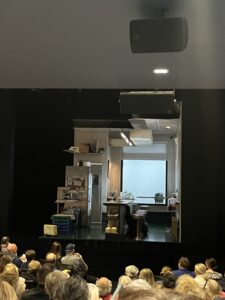
I felt that the play took a while to get me interested, as the first half seemed very repetitive. I did find it cool how they utilized the lights to make a day and night cycle. The set design was also really cool, especially considering it took place in one small set. I liked the use of the frosted window as a way to show a character’s exit. I think I also felt a little bored with the idea of there being only two characters for the majority of the play. It made it seem like each part was extremely drawn out.

In terms of story, I did not get most of the jokes and saw it as a sadder play. I think the acting was really good especially when the male actor recounted his experience taking care of his dying family members. I thought that the inclusion of his affair was a little sudden, and was surprised it was a major plot point. It was still very emotional, and I think it was the best acted part of the play. I think the ending being ambiguous was a little confusing, since the story felt like it was just starting to ramp up. The sudden ending had me thinking that there would be a continuation and that the ending was not finished yet.

I think I liked Paul’s character better than Katie. I felt that she switched up her opinion on two major events way too quickly, with no explanation. At first, she absolutely refused to poison Paul, yet as the story went on, she seems more open to doing so without reason. Secondly, she criticizes Paul for his affair with the doctor initially, yet she later supports him in trying to rekindle the relationship due to them having chemistry. The sudden change of heart was pretty confusing and made her character a little unlikable.

Overall, I think the play was an interesting experience and I definitely enjoyed it more than I thought I would. I think this play could have some improvements, especially with the ending, but overall, it was a great experience to go with friends.

The Counter at Roundabout Theatre – Amanda Alencastro

On Sunday afternoon, I endured a traffic-filled trip into Manhattan to attend an Off-Broadway performance of The Counter at the Roundabout Theatre. I was unsure of what to expect from this play, as I had only previewed a short synopsis about its plot to get a general understanding about what I would be watching. I knew that it would be tackling heavy topics such as suicide, so I was prepared for this aspect. However, there were various characteristics of the show that surprised me.

When I took my seat in the theatre, I opened my Playbill to skim through it. I thought it was interesting that there were only three members of the cast that would be taking the stage. This contrasts my previous experience in attending theater productions because I am used to seeing large casts and ensembles perform with one another. I believe that the reason that the cast is so small is to help maintain the focus of the play. If there were more characters in the play, our protagonists, Paul and Katie, may not have been fully developed to the extent that they are at the conclusion of the show.  Providing backstory and emphasizing the manner of interaction between these two characters is crucial to conveying the story as a whole, and thus would have been less impactful if overcomplicated with unnecessary side characters. It may be arguable that Peg is a side character, but it is evident that her role in the play was critical, for she was able to reveal aspects of Paul’s life to Katie that he would not have been willing to share otherwise. This allows us to contextualize his current state of mind to further understand his choices.

Another feature of the show that surprised me was its simplistic set design. I personally believe that set curators and designers can be considered artists because they are responsible for creating visuals that lend themselves to the story, without revealing too much information. At some shows that I have attended in the past, there are frequent or periodic changes in scenery. I thought it was interesting that the set remained the same for the duration of the play, and I feel that this is intentional so that the viewers understand that our characters are the ones moving the story along, rather than them being moved. I did enjoy how the lighting would change to represent night and morning, which would signify a new day.

I thought that the dialogue itself was emotional and at times difficult to listen to. Both Paul and Katie had endured troublesome events in their lives. However, Katie chooses to handle her trauma by running away from it and refusing to / putting off confronting it, when in reality that is an important step to healing. In my opinion, one of the most impactful moments of the show is when Katie reveals to Paul that she had to have surgery due to medical complications and can no longer have children. You can hear the frustration and anguish in the actress’s performance. I feel that this signified how we as people do not always know what others have experienced, as this was triggered by Paul saying that she does not know how to take care of someone. We also learn that Paul’s brother and mother passed away, and he feels that they were the only people who were capable of truly loving him. Both Katie and Paul’s hardships provoke strong emotion in viewers and help us to gain insight into their actions.

However, I still have some questions about the ending of the play. I find it difficult for me to decipher whether the conclusion of the show is intentionally open-ended, with the purpose of provoking thought within the audience, or if I just happened to miss something; admittedly, I zoned out a few times due to the show’s somewhat repetitive nature at times. I am hoping that it is the former. If inviting viewers to interpret the final scene in a way that makes sense to them was the playwright’s intended goal, I feel that they accomplished this. While I was watching in the moment, I was anticipating Paul to begin exhibiting signs of a stroke, as I had somehow assumed that Katie decided to poison his coffee that morning. This is largely due to the long embrace that the characters share just moments before Katie exits the cafe. It felt like a final goodbye, so I was under the impression that she may have known he would pass away in a short amount of time. However, this did not occur, but that is not to say that this could not have occurred after the final scene concluded. This may have to do with playing into the pessimistic / optimistic nature of viewers, as pessimists may be more inclined to assume that Paul’s life would shortly come to an end, while optimists may assume that this long goodbye signifies an end to Katie’s temporary solution of running away from her issues, as she leaves to meet up with her estranged friend/lover who she has been ignoring for two years. This epitomizes how this play, much like any art, is subjective, and can hold various meanings to different people depending on the general outlook on life, which can be impacted by both their lived experiences and the world around them.


Art Lab at Snug Harbor

Brendan Kwan

14 September, 2024


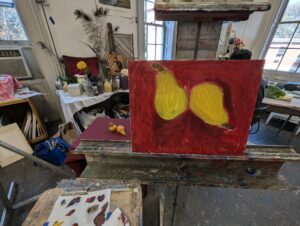
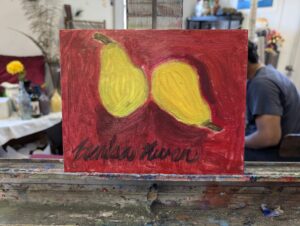
My friends and I decided to go to the Art Lab at Snug Harbor. We decided to participate in the Oil Painting segment. We met a nice artist named Griselda. She taught us how to utilize our eyes in order to fully understand the dimensions and of the object we are trying to draw. The object that I had to draw was a pair of pears. At first, I thought my art piece was going to be horrible just from the outline. As it came together, I stopped comparing my pair of pears to other people’s pairs of pears and started to really focus on my art, and surely enough, it became a masterpiece in my eyes. I began to mix colors in order to get somewhat identical colors as the real pears. I then focused on the background of the pears. Following that, I started mixing colors in order to make shadows for the pears. I was really surprised by how nice my pears turned out. Finally, when all was said and done, I signed my piece with a fine tip brush, giving it nice, slow strokes in order to write it neatly. The main lesson I learned during this art lab, is that even if you do not have much experience with art, anything is really possible

“Del Monte Profits From Apartheid” Poster

This was one of several posters created during the 1980s, encouraging civilians to boycott goods that were produced by non-white South Africans under the existing apartheid state. Protest art in South Africa during this time period often came in the form of posters, calling people to action to join in marches, boycotts, or anti-apartheid organizations.

The Apartheid was a set of policies in South Africa instated by prime minister Hendrik Verwoerd, which segregated white and non-white (Black and Indian) people. Non-whites were forced to live in different areas, received less education, were restricted from voting, were banned from interracial marriage, and were exploited for labor. Corporations like Del Monte profited off of the slavery-like conditions that non-white South Africans were forced to work under. This particular piece depicts a very gestural image many Black South Africans working in cramped quarters at a Del Monte food processing plant. They lack defined facial features, showing how corporations simply saw these workers as a means of production rather than individuals deserving of rights. They didn’t want consumers to view workers as human. The women in the center of the image is drawn with detail and a concerned expression to remind the viewer of the people behind the production of the goods they consume.

Political/Protest Art: “White Squad V” (1984) by Leon Glob


My piece of protest art expressed opposition to the brutal violence of the far-right death squads in El Salvador, which were part of extremist paramilitary groups that terrorized their own people and which were secretly funded by American aid. This work was critical more broadly of all of the far-right death squads in Latin America which were supported by the US in order to suppress far-left revolutionaries. These extremist militant groups killed many innocent people in order to stamp out communist political movements, yet many of their victims were not even communists, but centrists or people uninvolved in politics altogether. This piece of art was important because there was American support-as part of the Cold War-for brutal regimes and groups which devastated the lives of innocent people for political purposes. America sought to support these anti-communist forces even though they carried out tremendous violence. There was a lack of awareness among the American public of the kinds of atrocities which were being perpetrated by those with US support. Additionally, there was also a lack of concern-likely due to racism-for the lives of Latin American people, who were viewed as pawns in the greater geopolitical struggle against the Soviet Union. Golub used this protest art to awaken American hearts to the injustices being enabled by the American government. He portrayed the victims and perpetrators with white skin in order that his American audience could connect to the violence. The portrayal of a policeman who is wearing a uniform which looks American also taps into the American understanding of police violence and seeks to apply that experience to the terror occurring in Latin America. Today this painting resonates very differently because it just appears to be an American policeman to a contemporary eye rather than a foreign militant force. Modern onlookers are familiar with images of policemen wielding their guns and forcing innocent people to the ground and this image evokes an objection to unrestrained police violence. Additionally, the kind of power which is exerted over the civilian depicted and the villainous resentment displayed by the officer’s facial expression provides the American viewer with a sense of cruelty. The officer displays total callousness, which is an appalling indictment of what the justice system does when contrasted with how it ought to act. Those who are more geopolitically acquainted may see in this work an allusion to the kinds of US military aid which is still given to ruthless forces-like Saudi Arabia in prosecuting their horrific war in Yemen. However, the average American viewer of this piece today feels the brutishness of the American police above anything else.

Art Lab Open House Event at Snug Harbor

          I decided to visit the Art Lab at Snug Harbor with my friends, as they were hosting an open house free of charge. We chose to enter an oil painting exhibit, where we were introduced to an oil painting artist. She shared several facts about these paintings, one of them being how the illusion of 3-dimensional objects in a 2-dimensional painting are created. Farther objects are usually colored darker and closer objects are colored more vibrantly because that’s how humans perceive things. Some of her paintings scattered around the room clearly displayed the illusion she described. 

          She then set up a hands-on activity for us to paint one of the references out of several that were present. Our options were to paint tomatoes in a basket, two pears, two pumpkins, or a fennel. I chose the pear, because it was nice and simple and I could focus more on the color details rather than the shape, as it was mostly circular and smooth. We had several different colors to choose from, and we were allowed to mix them in order to make the painting as best as possible. I wanted the canvas to be positioned vertically, so I only painted one pear and half of the other pear. The artist gave us the color blue at first to make an outline because it was her favorite color to start with. I found it weird because I always assume that people would use the color black to make outlines. After finishing the outline, we added colors to the painting. In my painting, I colored the middle and top of the pear with a lighter color, and the sides and bottom with a darker one, in order to take into account the light and shadows and to try to accomplish the 3 dimensional effect. Then for the color of the table cloth, the artist seamlessly mixed the colors for me to make it as close as possible to the real one, which I found very impressive. To make the shadows on the cloth, I made the color slightly darker. After completing the drawing, in my opinion, I didn’t successfully pull off the 3 dimensional illusion. However, I did a lot better than I thought, therefore I am satisfied with my painting. 

          Overall, I really enjoyed this experience. Although I only visited one exhibit, there were many others, so I could only imagine what else I could’ve learned or seen. I would definitely go again with my friends to see what else they would have to offer.