Posts

Trip to Whitney

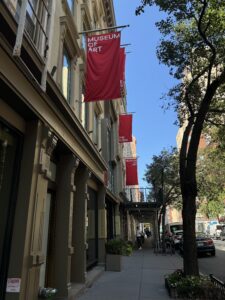
My initial impression of museums has always been negative so this wasn’t much different. I thought this would be just as boring as the other museums I have visited. Even though my visit didn’t start as I planned, I was definitely pleasantly surprised. I actually planned to visit the Rubin as I heard good things about it and it was the most convenient to get to. Unfortunately, that visit ended up being very disappointing. When I arrived I was greeted with locked doors, I had no idea the museum was closed on Mondays. I did however take a picture of the outside so that was nice;) I ended up taking a bit of a detour to the Whitney, which actually took me by surprise how much I enjoyed it. Despite it being more modern art it had some great pieces.
The first art piece that captured my attention was by Blythe Bohnen.
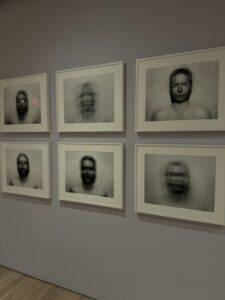
This was a unique piece that focused on the use of motion in order to capture a self portrait. It is strange because typically in a self portrait you are able to view every detail of the subject however this art piece is very up to interpretation. It portrays a moment in time that should show facial features of the subject but rather gives the viewers an unsettling and obstructed view of the portrait. There is no tell of who the person is but it feels like you can create a story based on the mere interpretation of their eyes. This piece pushes the viewer to imagine their own version of the self portrait as what is show is just a fraction of what it could be. Art is subjective, and just like John Berger believed, the camera can only capture so much in a moment of time. It made me understand that personal identity can be beyond a strict and motionless interpretation and rather a fluid and ever-evolving state. On the surface, I see a simple portrait, however upon further analysis I feel the complexity in the personality of the subject. The repetitive motion suggested to me the idea of cycles in life. Furthermore, the various phases of individuals lives that can’t be seen in a simple painting but this piece helped me see the complexity of the different phases of people’s lives which they continuously revisit and reinterpret with their identity. Overall, I was really drawn to this painting, however, it was odd since going in I had such a pessimistic view and the first painting already struck me. 

The next art piece was by Edward Hopper.
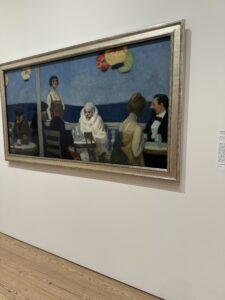
This painting was unique in its color. It was very bright and the strange addition of a clown drew me in. I was fascinated to learn what the original intent or the painting was because I had already made an interpretation on my own. The original purpose was an account of the artists experience in a Parisian art school where they combined numerous visits to different cafes and added their interpretation of the people around. To me, it touches on the divide in society today. Furthermore, the idea that there is always an outcast that sticks out like a sore thumb which is illustrated by the clown, while the people are clear critics for no apparent reason. It also touches on the idea of self awareness because how you see yourself may not always be the truth. The clown can portray that you are your worst enemy, and that not everyone is out to get you. It may always seem that you are the center of attention hence the portrayal of the clown in the center but it is foolish to think so. The piece made me feel a sense of coldness and isolation due to the high contrast of the colors. The calmer colors invoked a series of melancholy thoughts and contemplation that pushed a theme of emotional isolation which the subjects faces revealed. It seemed like even in a social setting everyone was so disconnected, much like the world today with advent of technology. Overall, there was nothing that I didn’t like in this piece, it was very complex and promoted deep thought. 

The next piece was also by Edward Hopper.
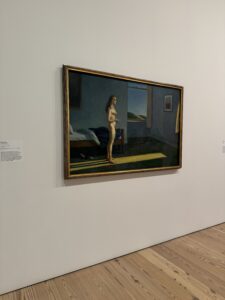
Initially, when I saw this painting, I walked right by it, however, upon second glance, I realize it was not much different than the paintings that we analyzed from John Berger’s book. I went back to see how the artist described this painting since much like the painting by Van Gogh that initially didn’t mean much without the words attached, this painting didn’t mean much without the words attached. After reading the purpose of the art piece it changed my perspective on it overall. The model in the painting was the artist’s wife who was 78 at the time of the creation of the work, however instead of painting, the realistic details, he created his everlasting idea of her from his memory. This open ended scene allows viewers to create a narrative of their own. This made me think of the quote from John Berger’s book about the difference of nakedness and nude. As the quote describes, you can be naked at all times, but it is only considered nude when you were viewed by others, I believe the artist wanted the viewers to understand the painting in that perspective. The use of light on the model pushes a theme of detachment from her environment which I interpreted as her careless persona. Yet I think this application of light does not idealize the woman’s isolation but rather exposes it. Her body language makes me think of a state of quiet contemplation and solitude. I feel like her nakedness goes beyond physical state but is also emotional and psychological all at once. To me, it felt like a raw depiction of a woman’s state and not one that is idealized.

The last piece of art was by Carmen Winant.
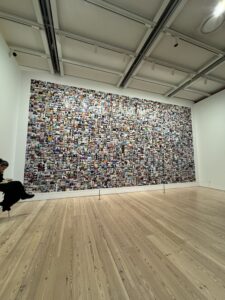
Although, I liked the message of the art piece it seemed too elementary to be considered art. Yes, the progression of the photographs was moving in the sense that it showed the evolution of the female reproductive rights but do I consider this art, no. Overall, this was not one of my favorite art pieces, the meaning was great but the portrayal not so much. There was no real deeper meaning that I could continue to analyze and that is something that I appreciate in most art pieces.

To conclude, my visit to The Whitney changed by view on most art museums as there can be art for everyone. Even though, museums are still not my favorite activity it is fun to analyze the deeper meaning of art pieces. I would visit the Whitney again with friends, I had a great time and all the exhibits were so unique.
Trip to the MoMA – Suzanna Grigoryan

I do not typically visit museums, but when I do, it is either part of a school trip, or a spontaneous side-activity on vacation. Needless to say, I am not much of an art fanatic, so the idea of spending a Sunday morning at the Museum of Modern Art did not seem too appealing. In the past, I have never been able to seriously approach artwork in the given setting because I view it as a hobby rather than the generally accepted conception of a constant “hidden meaning”. Therefore, stepping into the vast array of displays within the MoMA, I told myself that I would attempt to consider everything through an unbiased perspective, trying to understand the so-called “deeper meaning” and “communication” of art. Unfortunately, my perspective remained unchanged, as almost every floor filled me with laughter. The reason I say “almost” is because despite my inability to accept the fact that every piece of artwork contains an indisputable underlying significance, I still appreciate the effort that certain artists invest into the production of their works. There were definitely certain views that looked pleasant, however the overwhelming majority, at least in my opinion, consisted of work that could either be recreated by children, viewed online, or simply not even viewed at all.

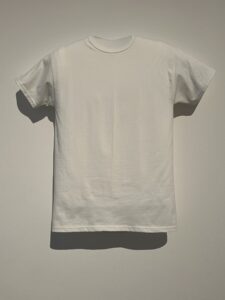
Hanes, Inc. White T-Shirt. 1910s

I began with the second floor. The first piece that shocked me was the White T-Shirt by Hanes, Inc. My immediate instinct was to laugh at the thought of a plain, white t-shirt hanging on display at a museum that international tourists come to visit. Upon further analysis, I noticed that the shirt conveyed noteworthy history. A plain shirt does not randomly appear in a store. It undergoes multiple procedures, from the manufacturing of yarn from cotton, into textiles, imported into warehouses, and so on until they are ultimately packaged and shipped. Labor activist, Kalpona Akter, shares, “When you buy a t-shirt, it just costs you $5 or $10. But no one talks about the workers who made them.” She proceeds to note that the minimum wage in Bangladesh is $95 a month, a fact that is extremely unfortunate and almost unbelievable. Overall, the presence of the shirt indicates the history behind its production, such as the unjust treatment of factory workers regarding their unfair wages and isolation from fundamental rights. Akter urges the audience to not feel sad, but rather feel angry in such a way that allows the use of this emotion toward making a difference for people. “If there is injustice, someone always can stand up and speak out. If there is someone, why not you? You have the power to make that change.” After delving into this context, I definitely found the piece eye-opening, crucial, and considerably empowering, as it caused me to think of the abundance of clothes purchased that have been “Made in Bangladesh”, along with the privileges I may take for granted on a daily basis, yet those of which are not accessible to other populations of the world.  Although there is a proven “message” within the white t-shirt, I believe that placing it in an art museum is unnecessary as well as unfitting, for the information conveyed to me through the display of this cloth could have been communicated through simpler means.

Salvador Dalí. The Persistence of Memory. 1931

Having briefly previewed the exhibitions of the MoMA prior to arrival, I paced around the museum searching for a specific work of art, Salvador Dali’s The Persistence of Memory. The reason I was eager to find this painting was because of two reasons. Firstly, as part of an elective requirement during the sophomore year of high school, I took an art class during which I remember learning about Salvador Dalí and his niche of surrealism, being presented with this exact painting. Secondly, the summer of that same year, I visited St. Petersburg, Florida, and coincidentally came upon The Dalí Museum, which happened to be one of the main tourist attractions within this small city. So, I walked around the same way I did in the MoMA, treating the artwork frivolously and with comedy, however leaving with a sense of dissatisfaction that The Persistence of Memory in this museum was not an original work. Hence, I did feel a sense of fulfillment when I finally found the real painting I had already been familiar with and learned about, at this museum. It was truthfully underwhelming in appearance due to its small size and disrupted visual appearance, caused by glares and dim lighting. Examining the history of this painting, one learns that surrealists were a revolutionary movement with a goal of destabilizing political, societal, and cultural norms. Apparently, Dalí liked the state of becoming and unbecoming, which is expressed through the decay-like essence of the melting watches and the flies that surround them.

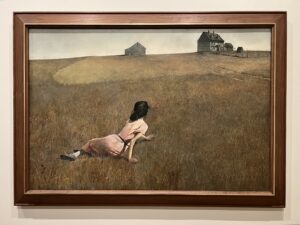
Andrew Wyeth. Christina’s World. 1948

Unintentionally, I stumbled upon Andrew Wyeth’s Christina’s World, which was placed within a narrow passageway, leading from one section of the fifth floor to the other. Coincidentally, this also caught my attention among the arrangement of plentiful other bores, for it was also taught within the same sophomore year art class previously mentioned. It felt nice and somewhat rewarding to be familiar with the foundational circumstances of this painting prior to reading further about it. This painting is inspired by Wyeth’s neighbor, Christina Olsen, who was victim to a neurodegenerative disease, losing the ability to walk by the time of her late 20s. Christina resisted the aid of a wheelchair or crutches, choosing to propel herself with the sole support of her arms. I found this background of Christina’s challenging life exceptionally inspirational. A fact I did not know was that the depicted figure is only partially that of Christina’s, for Wyeth’s wife was used as a model for the hair, torso, and some of the arms. This undeniably raises ethical concerns, as viewers question the implication of a disabled individual’s experience being modified by the depiction of someone who is younger and in a non-disabled body.

Overall, there was a lack of personal connection between myself and the exhibited artworks. I found this trip around the MoMA fairly meaningless, as none of the works particularly resonated with me, however an activity that I enjoyed significantly more than viewing the displays was analyzing other visitors, some of which were tourists, students, or regular locals. It is always interesting to detect the substantial distinction between how others approach art in comparison to myself.

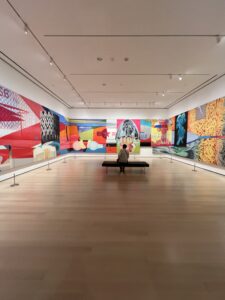
For instance, I walked into a room filled with art that looked like nothing more than a bunch of vibrantly colorful drawings, only to be met with a man that was sitting right in front of the piece, dissecting every, arguably nonexistent, detail. It almost seemed as though he was being engulfed by the world of these paintings, which only seemed like insignificant colors to me, and that in itself, was a more captivating sight than any of those I had previously walked many stairs to look at.

Rubin Museum

I decided to visit the Rubin Museum of Art, accompanied by my sister. As somebody who has had a lifelong interest in cultures other than my own, the idea of seeing an exhibit filled with Tibetan and Himalayan art and culture, which I admittedly do not have much knowledge of outside of a high school world religion class, tantalized me. Another major factor which spurred my visit to the Rubin specifically was the unfortunate fact that it is closing its Chelsea location in favor of becoming a virtual museum. Thus, I made my journey to Manhattan–a rather comfortable one thanks to the humble SIM1C. 

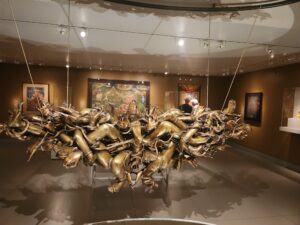
As I made my way into the museum and up the stairs to the second floor, I was entranced. Glimmering golden tapestries and ornate copper statues were a visual treat. One of the first pieces I had noticed that truly struck a chord with me, and which dwelled in my mind for the entire duration of my visit to the Rubin, was a tantric copper statue of the Vajradhara Buddha with a consort. As I examined their intertwined bodies, Berger’s discussion of sexuality as depicted in Eastern art as opposed to Western art in Ways of Seeing immediately came to mind. Berger detailed that Eastern art never objectified women as European art did. Instead of being objects of male sexual desire, naked women in Eastern art were depictions of sexual love between two people. I found the depiction of sexual love in this statue refreshing compared to the idea of the female nude so prevalent in the old European canon. 

A bit later into my visit, I encountered something I had never seen the likes of at any museum I have ever been to. The Mandala Lab was an interactive exhibition created by contemporary artists which was based on core Buddhist tenets and meant to stimulate all of one’s senses, not just sight. Personally, I found the scent library to be among the most interesting aspects of the Mandala Lab. It involved six different stations where one would press a button and a scent created by master perfumer Christophe Laudamiel would be blown at you. From there, you would choose emotions on a wheel and describe how the scent made you feel. Each of the six scents were created in collaboration with artists who connected them back to a specific time of their life. They ranged from cigarette smoke and the smell of the earth after rain–two scents which, unfortunately for me, aggravated a migraine–to temple incense, which I found the most pleasant. 

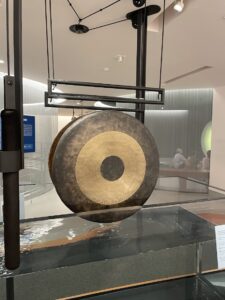
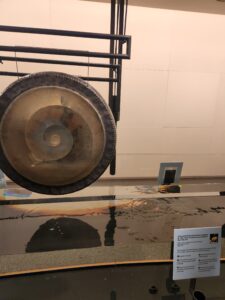
Aside from the olfactory experience, the auditory experience was definitely among my favorites. Designed for the museum-goer to express their anger, it involved a collection of gongs which were designed by various artists in differing size and shape, and therefore sound. The instructions were to think about your anger, strike the gong with the mallet provided, and lower it into a pool of water to see how it altered the sound. To me, it served as a testament to transforming anger into something productive, something beautiful. As I struck the gongs and heard their reverberations alter after being lowered into the water, it made me examine how I can transform my own anger; how I can transfer that negative energy into something positive.

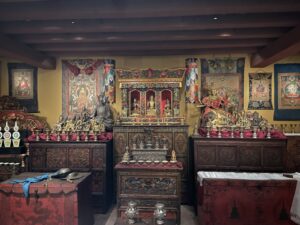
Something else I enjoyed about the Rubin was the Tibetan Buddhist Shrine Room. I have never had the opportunity to go into a house of worship other than my own church, so I highly appreciated having such an opportunity at the Rubin. My initial impression of the Shrine Room was how profoundly beautiful and ornate it was–as a Catholic, I must say that I have quite the penchant for the ornate. The room was dimly lit and the soft smell of incense wafted through the air. To me, it was entrancing. The appliqué tapestries adorning the wall along with dozens of little statues and candle holders almost reminded me of stained glass windows and offering candles in a Catholic church–though I obviously know the two are completely different, it proved to me how universal and innately human the appreciation of beauty in worship is. 

(My picture may seem brighter than how I described, but that’s just thanks to my overexposed phone camera.)

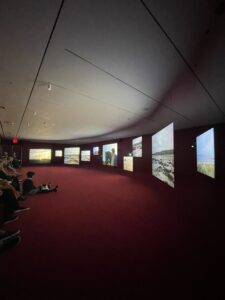
One of the last things that I saw at the Rubin was a short film, Yarlung (2020), directed by Kunsang Kyirong, a Toronto-based indie filmmaker. Yarlung follows the story of how three children cope with the death of their mother, and how the Yarlung Tsangpo river allows them to cope and deal with their immense loss. For them, the river is both sacred and a comfort to them in a difficult time: they played, swam, and fished in the river, like the village children generations before them. There was also an ongoing motif of their grandmother’s tea, another comfort to the children. The way they took refuge in nature almost struck me as Romantic, which I appreciated. Visually, the film was beautifully animated in a simple charcoal-drawn style that I found comforting. Tea and the river were intertwined in the film, or it seemed as such to me, as ancient, time-honored comforts to the people of Kyirong’s village. In its five minutes, Yarlung conveyed a powerful message about finding comfort in simplicity and the familiar. Not only were the children able to find peace, but I felt that as a viewer, the environment Kyirong created in the film extended to myself as I was watching–it even made me feel more relaxed. I found that Kyirong was able to deliver such a strong message in five minutes what some renowned directors are unable to do in two hours, and I commend her for that. 

The Rubin museum is easily one of the most beautiful museums I’ve ever been to, aesthetically and otherwise. Exposing myself to a culture I knew next to nothing about certainly paid off, as I feel my visit offered me some insight into Tibetan culture. Although it is an absolute travesty that the physical building will be closing, I left the Rubin with a strong desire to learn more about Himalayan art and culture and will definitely make an effort to do so.

My First MoMA Experience! by Angie Mekki

♥A Day’s Beginning♥

Going to the Museum of Modern Art (MoMA) was a very new experience for me, which made me fall in love with the idea of going to more museums, especially with a friend! My friend came to visit from university, so he became my victim in assisting me with my seminar homework. We disagreed on some works of art, and others moved us to tears. I have never been in a room of art where I had to say “This is getting too much for me, I need a break,” due to overwhelming emotion, and MoMA did a great job at portraying artworks that evoked such emotion in me.

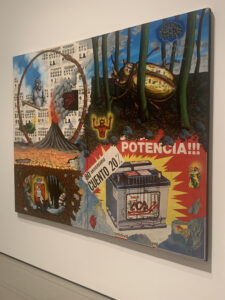
♥Exhibit 1: In the Shadow of the American Dream (Wojnarowicz, 1987)♥

Street artist David Wojnarowicz used the four elements (earth, fire, wind, water) to symbolize the hidden downside of the American Dream. This element was supposed to represent Fire. As a first-generation woman of color, I felt very moved by this piece especially, since my family had moved from their home country in search of the American Dream. Like most families who search for dreams, many do not realize that dreams are exactly what they are: dreams. Dreams are perfect, whereas our world is not. Wojnarowicz highlights the atrocities behind the American Dream that people experienced in the 80s. The time period is significant due to the rising AIDS epidemic, and this piece encapsulates the rage people felt during this difficult time.

♥Exhibit 2: Monuments of Solidarity (LaToya Ruby Frazier, 2008-present)♥

One particular exhibit that brought us to tears was a documentary by LaToya Ruby Frazier in protest of the demolishing of local hospitals with the rise of toxic pollution in Braddock, Pennsylvania, and limiting access to healthcare. I grew up with a need for emergency healthcare access, and looking at these photos made me feel so heartbroken. I sympathized with Frazier’s hurt and anger toward the lack of concern for citizens, especially those who come from marginalized groups. To me, the worst part is, that this is a fairly recent issue and an enduring one, where many people in America and all over the world still struggle to access basic human resources. Frazier continues to create art in forms of protest even to protest the issue of scarcity of clean water in Flint, Michigan.

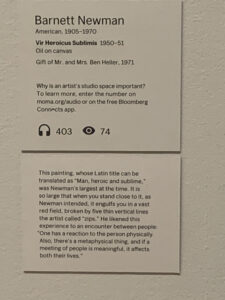
♥Exhibit 3: Vir Heroicus Sublimus (Barnett Newman, c. 1950)♥

On a less political and somber note, this art piece intrigued me (though my victim was not amused by it). It is a completely red canvas, and if you stand close enough to it, the lines, or “zips” as Newman calls them, break apart the red field. Some parts looked asymmetrical, and this was meant to symbolize human relationships. My friend did not think that this was a valid art piece. “It’s just a red canvas with lines,” he said. But the connection is, if you look closely, you’ll see all the different asymmetrical aspects of the painting, like how if you look closely into a person’s soul, you’ll see and understand who they truly are. I personally enjoyed the humanity behind this piece, especially the fitting title, which translates to “Man, heroic and sublime.”  However, my friend may be right. Upon seeing this piece, I was interested, but maybe because it was displayed in a museum. Maybe if I saw this on the internet or the street I’d scoff and say, “Why am I looking at a red canvas with lines?”!

♥Conclusion♥

Overall, this was an amazing, fun, and inspiring trip. I learned so many different forms of expression I did not know existed. As a kid, museums always sounded boring to me, but this is like a different home. I walk in, and I feel seen and loved by all the photos speaking ever so tenderly to my heart. I would love to go back anytime soon, and I would love to go to a scientific museum soon as well! Museums have now piqued my interest, and the outcome of this trip is not disappointing!


The Rubin

The trip to the city was extremely rough; the subway and ferry were a mess as always. However, when I finally arrived, I had a great time. I spent the day with friends, and we enjoyed a visit to the museum, followed by dinner and shopping. The museum itself was beautiful and featured art from all over Asia. Additionally, the food my friends and I had was amazing.

Asian art is quite different from European art. In my opinion, the main difference between Eastern and Western art is the way scenes are depicted. In Asian art, sculptures and pottery are more prevalent, while Europeans traditionally painted on canvases or stained glass murals. Although I generally prefer European styles, visiting the museum opened my eyes to the beauty of Asian art. The statues of the Gods were intricately detailed and vibrant, and the paintings, when present, were often more rooted in reality than their European counterparts. This contrast highlights the unique beauty of life as seen through different artistic lenses, compared to European art, which often portrays an idealized vision of life.

When walking around the Rubin, three pieces of art struck me much more than any other:

Art piece #1

Shakyamuni Buddha

This painting of Buddha bears a striking resemblance to how Europeans might depict God. In Buddhism, Buddha is a teacher who guides people toward achieving nirvana, and this painting reflects that perfectly. As the central figure of the religion, Buddha is depicted in the middle, surrounded by the events of everyday life. Despite the chaos around him, he remains calm, embodying the inner peace he has attained.


Art Piece #2

This piece of art reminds me of our conversation last week about women in art. Unlike traditional representations where women are often portrayed as objects of the viewer’s gaze, this sculpture presents a woman who exudes power. In this work, it is not up to the viewer to interpret her role; rather, the artwork itself conveys her identity and strength.

Art piece #3

Bhavacakra Wheel of Life and Death

This picture represents the Buddhist view of the cycle of life. The intricate coloring and detailed drawing illustrate how Buddhists perceive death, life, and rebirth. This image, along with the others, is very pleasant to look at. The style differs significantly from traditional European painting, but it effectively conveys the Eastern perspective on life. Each piece reveals beliefs about death and how people should live their lives.

The Rubin Art – Michael Gardella

The Rubin Museum features pieces of art from 32 different artists related to Buddhism. This stems from various cultures, including those of Central Asia, India, and the Himalayas.  The four works shown below all portray the difference between past and present culture and technology.

The Windhorse

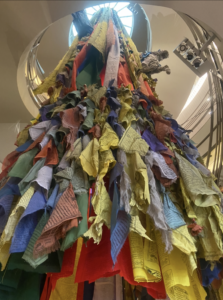
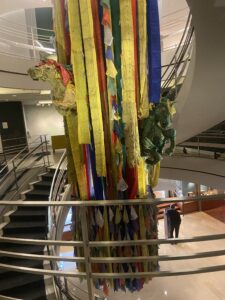
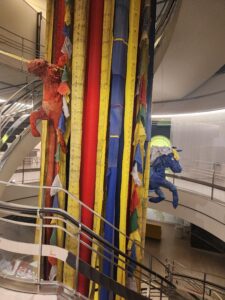
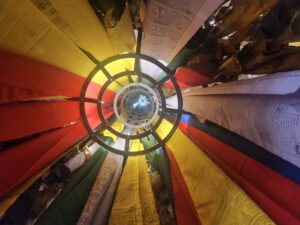
The most notable piece of art at the museum was the hanging cloth in the middle of the staircase.  This piece is almost 6 stories tall and is composed solely of a variety of different cloths, differing in color and shape.  The location of this work in the stairwell is symbolic of the way people go from Earth to heaven, which is represented by going up the stairs.

At first, I noticed the color scheme and the cloth structure, but I didn’t realize until I got closer that each cloth had writing on it.  The writing consisted of various discarded prayers that were put together to form this immense work.

There were horses made of the same fabric protruding on each side for each layer.  These five wind horses were adopted by the Buddhists, and they represent fortune and wellbeing, especially in ones’ journey to their afterlife.  This part really intrigued me.

Although this piece wasn’t a typical painting or statue, I believe it was one of the best pieces of art I have seen here.  Its immense size and detail made this the most significant work in the exhibit.

The Uber Rat

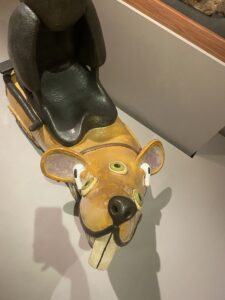
This piece of art showcases past culture integrated with todays technology.  The artist, Shushank Shrestha illustrated a divine being, represented by the three eyes, needing modern conveniences.  The Uber Rat is supposed to be a mix of a rat and a car, which relates to the hybrid technology in todays society. 

The three eyes on the rat stood out the most, along with the giant teeth.  The artist was inspired by the uber drivers in New York City, so he incorporated the air pods.  In addition to this, the overall appearance of the rat looks much like a rat you would see in the city.

The Red Strings 

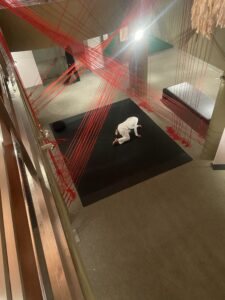
When I first walked into the museum, I noticed red strings connected to the railing.  On the first floor, there was what I thought was a mannequin in the middle of the red strings posing.  When I went downstairs, I noticed she started moving.  I was disturbed to see that she was being used as art. 

This exhibit was the only part of the tour that I didn’t appreciate.  I found it hard to interpret and connect to.

Monkey Mask

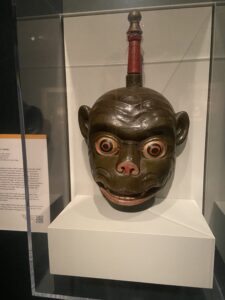
The monkey mask shown below was used in monastic festival dances to teach karma through the Lord of Death.  The monkey is said to count out white and black stones, which represents an individual’s good and bad deeds.  The peg on the top of the mask was used to help the wearer conceal their head and become one with the monkey.  I thought the peg stood out the most, especially because of its large size in relation to the rest of the mask.

Overall, I believe the art was well crafted and really symbolized the Tibetan culture.  I personally couldn’t connect to the art, but I did appreciate the time and detail put in most of the pieces.

My trip and experience in the Rubin Museum

On Saturday I visited a museum, the Rubin Museum of Art. This was the first time I went to a museum in the past 3-4 years, and I went with a group of friends. It all started with the commute to the museum. The commute was not the best, and it did take time to get there, especially because someone came late to the ferry and made us miss the first one (Brendan). When we finally got to Manhattan after an hour, we took a train to Rubin, and during that train ride we saw some strange things that confirmed that we were in New York. Besides that, I enjoyed socializing with friends during the commute. When we got to Rubin we paid for our tickets and went up a lot of stairs getting tired before we even started our viewing of the museum. After we finished looking at the museum, we all found something that stuck out to us. For me, there were 3 pieces in particular. Those 3 being: The Vast Bhutan, Muted Expressions, and The Gongs.

The Vast Bhutan:

This piece stuck out to me for three main reasons. Those being that it was very big, colorful, and that it was made out of Bhutanese prayer flags. These Bhutanese prayer flags were found on the floor or in other places and were taken and made into this art piece. This art piece spans the whole museum, going from the top floor to the main floor. This piece has 5 mad horses in it, each a different color. The five colors being: yellow, green, white, blue, and red. Each color symbolized a different thing. Yellow symbolizes wisdom and earth, green symbolizes equanimity and water, white symbolizes purity and air, blue symbolizes endurance and space, and lastly, red symbolizes compassion and fire. The horses are called mad horses because they symbolize the negative effects the flags have on the environment, even though they are meant for protection. These horses are the Lungta, and they carry the prayers from earth to the heavenly realm.

The Gongs:

This piece stood out to me because of the physical aspect and that the person themselves gets to interact with the art piece. The point of this peace is so that you channel all your anger into the gong and then you hit it lightly. This hit puts all your anger into the gong, which you lower into some water. This makes the water absorb your anger, and it starts to shake. Later the water becomes still again, and this is supposed to symbolize that your anger has dissipated. There were multiple different gongs, each a different size, and each made different noises. I interacted with this art piece but felt nothing. That is because during the time of me hitting the gong, I had no anger to channel into it, thus making me feel nothing.

Muted Expressions:

This piece stood out to me for a single reason. That reason is because of the meaning behind this artwork. This is called Muted Expressions, and it was made by Tsherin Sherpa. This piece was made after the 2015 earthquake in Nepal that killed over 9,000 people and injured over 20,000. One part of this piece that stood out to me was that there were two hands in that artwork that were barely touching each other. This is supposed to symbolize a man and a woman’s last touch before they got separated due to the earthquake (I got told this by a worker in the Rubin Museum). This just added to the meaning of this art piece to me. This is why the artwork left a standing impression on me.


These are the three pieces of art that stuck out to me in the Rubin Museum.

MoMA Visit Transcend Into Living Art – Sasha Smolansky

At first glance, the MoMA may be regarded as an extravagant waste of square footage, filled with merely a collection of splatters and errors on a canvas by artists who failed to achieve conventional acclaim. Instead, to compensate for their lack of traditional talent and to inflate their fragile egos, they decided to invent a unique section of art such as realism, cubism, abstract, and modern art. Entering the MoMA, this was my rigid and unyielding opinion that was extremely stubborn to change. My skepticism was only solidified as I explored the first floor, where the galleries seemed to merge into one single, unremarkable blur. I was unaware of the profound depth that modern art was capable of encompassing, and it was only until I reached the sixth and fifth floor when my understanding began to shift. Until that point, I maintained that in order for art to be considered beautiful, it must conform to my limited and narrow notions of what beauty is in order to be defined as art. 

However, as I continued to explore the museum, I began to realize how art has the power to unite people. Though they may understand the piece just as little as I do, they sat together, stared, pondered, and discussed its potential significance. It became evident that the essence of art lies not solely in immediate reactions or understanding, but in the curiosity and connections that it is able to foster. Therefore, alluding that true beauty in this world is not always obvious or plainly evident as one may wish it could be. It will rather emerge through the process of shared exploration and interpretation with another human being and as we immerse ourselves into the art, we become an extension of the original work that now transcends the confines of the frame.

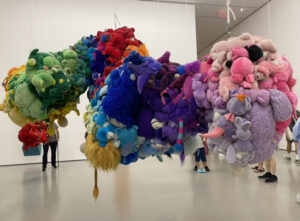
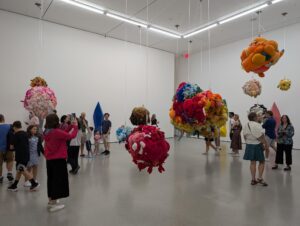
One of the first exhibits I experienced at the MoMA was the entrancing Deodorized Central Mass with Satellites by artist Mike Kelley. This piece features stuffed animals clustered in a cellular arrangement of one “central mass” and 13 “satellites.” In 1987 Mike Kelley began to make sculptures from stuffed animals, which he described as “the adult’s perfect model of a child”: cute, clean, and ultimately devoid of sexuality. However, Kelley’s plush toys, purchased secondhand from thrift stores and yard sales, were discarded and soiled from use. Seemingly beyond redemption, they are darkly humorous monuments to lost innocence and repressed trauma.

As these repurposed stuffed animals, now given new life, hung over us, we couldn’t help but become immersed in this moving display. Especially fascinating, I noticed that it was adults, in particular, who were deeply in awe and obviously affected by the piece. Where most art portrays an idealized version of the human body, leaving the spectator breathless and in adoration of the nude, Kelley’s work offered a stark contrast,  an opportunity to rather confront and move beyond the objectification so prevalent throughout art history. Only when we are able to stray from these desires and revert back to a state of simplicity, when we were essentially pure, are we able to appreciate his art and enjoy a moment of respite, thus, momentarily reconnecting us with a more unburdened part of ourselves, still naive to the evil of the world. Through his art, Kelley gifted us a moment of peace, a chance to breathe, take back our stolen innocence, and in a sense, forget our pain, even for just a moment, thereby, offering us a fleeting escape from the pains of adult life that we were so violently forced into.

Moreover, I found it remarkable how the artist is able to understand the audience so well (perhaps due to the fact that he is also touched by it, as this work is able to speak to a multitude of individuals) and create a piece, conceived so brilliantly that it is able to symbolically and physically intertwine with us. When engaging with the art, the spectators are able to reflect on their lives, thus coming to grips with their lost innocence. And where the animals were at first beautiful, suspended symbols of childhood and a once pure life, they soon become us and we become one with the piece, now draping the room, dark monuments to lost purity and trauma as we confront our memories and come to terms with our own vulnerability.

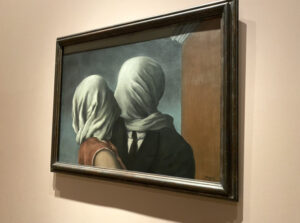
Another piece that deeply resonated with me was René Magritte’s The Lovers (1928). The longer I contemplated this work, the more ways I was able to interpret it. Its mystery only heightened my fascination with the piece as it invites each spectator to uniquely ponder it. Thereby, giving them the freedom to elucidate it, and infuse it with personal significance and relevance to their own life, just as I did.

At first glance I found that the painting suggests that we are blinded by our desperate desires, leading us to push and impose the illusion of our greatest longings upon others or to selfishly embrace a distorted vision of those closest to us. After meditating on this work for a few minutes, I felt an impending revelation that perhaps The Lovers are trying to warn us of the unease in being unable to unveil the depth and truth of even the closest people in our lives and consequently constraining us to love a lie fed to us, an illusion of who they truly are. This poses a compelling question and leads the audience to wonder whether or not we truly connect with the people in our lives, or merely entangled in a web of illusion and a facade they force us to believe and love? Furthermore, the work explores the paradox of our yearning for love while grappling with the fabrications from our partner, as despite it all, we long and hunger to be wanted and accepted. For this reason, we push forth despite the pain and suffocation accompanying the mystery in our partner and secrets they may hold. Their true intention may be concealed, nevertheless you accept what is being offered in the moment due to the comfort in the passion they offer and the solace in their deception, despite knowing that you are alone in a partnership, trapped, and struggling to breathe.

On the other hand, this piece may be speaking to another human struggle, the opposing side to the initial deduction: the inability to open up to one another. Though we are desperate for a genuine connection, we are haunted by our past mistakes, thus, making it challenging to trust ourselves to be honest and vulnerable with our partners. As a result, we persist in concealing ourselves under layers, unwilling and unable to reveal the essence of who we truly are.

Another piece that spoke to me was Marc Chagall’s I and the Village (1911). I was able to connect to his piece due to the striking parallels between our background and life experiences. Both Chagall and I grew up Jewish and have a shared connection to the Soviet Union. While Chagall emigrated to Paris, my parents fled their home, to the United States of America, to escape religious persecution. Nevertheless, our different paths did not hinder our ability to both be nurtured in an environment rich with Jewish culture and values. 

Chagall’s piece vividly and brilliantly encapsulates these values through its portrayal of peaceful connection, which is brilliantly displayed. Furthermore, his work manifests the gravity of creating a respect for coexistence with animals, thus reflecting a profound and pivotal part in Jewish tradition, the practice of keeping kosher. This therefore serves as a reminder of a deep sense of reverence for life, the environment and every single being that inhabits it. This mutual dependence is signified by the lines connecting the eyes of the peasant and cow which is fractured and fragmented through the visual language of cubism. 

Although I may not fully grasp cubism or find it particularly engaging, its ability to relate itself to a greater issue, deeply rooted in my heart, allows me to appreciate the style and message being conveyed in its entirety. To elaborate, Chagall’s approach, while abstract, powerfully and effectively communicates themes that are personally touching and proves that Chagall is especially skillful and inspirational in expressing profound concepts despite his fragmented art  through the universal language and. understanding of human emotion through the eyes. 

Leaving this museum, I felt transformed. I exited a different and perhaps a bigger person than I was when I first entered. Though it was difficult for some pieces and perhaps impossible for others to be interpreted, I was able to mostly recognize and appreciate beauty in minute details. To expand on this notion, this experience instilled a new ability to notice and appreciate the subtleties of the world around me. Thus, making me realize that in order to be truly grateful for what I have, it is crucial to recognize the significance in everything that encapsulates us as we are living and breathing art. Art imitates life, we are surrounded by a canvas and we paint it with our individual, vivid experiences and realities and we must always remind ourselves that artists simply allow us to revel in the art that is implicit in our own lives. 


My Trip to the Museum of Modern Art (MOMA) by Wilson Wu

INTRODUCTION:

     It was a bright, but soon to be long day on my journey to the Museum of Modern Art (MOMA). Throughout my childhood, I’ve never really had the opportunity to visit art museums due to my lack of interest in art during that time. As a result, I was very excited to visit the MOMA, as it’ll mark my first ever art museum visit in my life. After getting off of 7th Avenue station, I took a 20 minute walk straight towards the outside of the MOMA. Immediately when reaching there, I was impressed by the smooth entrance I was able to get into the museum. It was a rapid process that involved going through security, double checking that everything is in my bag, getting my CUNY ticket, and walking towards my first ever art exhibit.

SECTION 1 (FREDERICK DOUGLASS ART SECTION):

“Lessons of the Hour” by Sir Issac Julien


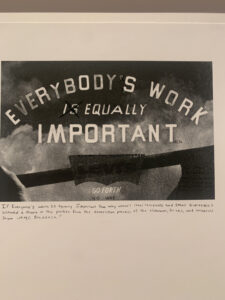
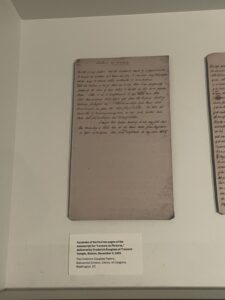
“Lecture on Pictures” by Frederick Douglass.jpg

     After walking around the 1st floor for a bit, I noticed a huge crowd of people walking towards a room that seemed to show some sort of movie in there. Upon walking towards the crowd, I was amazed to witness the popularity and works of Frederick Douglass. It was a name I hadn’t seen since reading his book titled  “Narrative of the Life of Frederick Douglass” in middle school. Even though I had a small glimpse of who Frederick Douglass was, reading his written documents on display gave me a refresher on his life under enslavement and his contribution to the abolitionist movement. It was also interesting to find a movie that was crafted in his honor, and was thus impressed by the clear historical events that Julien depicts in his Douglass’s narrative.

SECTION 2 (HISTORICAL ART SECTION):

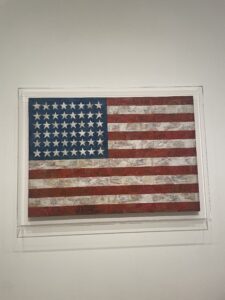
“Flag” by Jasper John

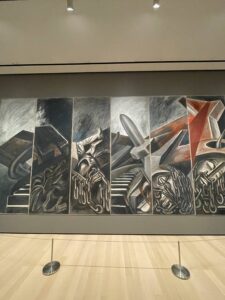
“The Charnel House” by Pablo Picasso


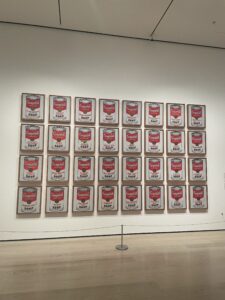
“Campbell’s Soup Cans” by Andy Warhol

     It was also very fascinating to see the works that were drawn within the 19th-20th century because they depicted the situations that were arising at that moment. Jasper Johns’s ”Flag”, for example, allowed me to see notable differences between our current flag and the flag before the United States acquired both Hawaii and Alaska as official states. Upon searching the modern-day American flag, I was able to see the pattern of rows to be strikingly different and the brightness of the color that was painted in contrast to the computer-generated image of the modern-day flag. Looking through Pablo Picasso’s “The Charnel House” I was fascinated by the message he wanted to convey of the horrors of World War 2. Picasso, at first, was never one bit interested in painting anything that pertains to the theme of war, however the spread of Nazism and dictatorship in some parts of the world strongly persuaded him to illustrate to his audience the negativity those ideals played in the 1940s. Upon my journey on these historical paintings, I’ve realized that many of them were referred to as “Documents” in my history classes, as they were used mostly to support our historical claims. An example of this can be “Campbell’s Soup Cans” painting, which highlighted the typical, universal diet of many American workers during the 20th century. I remember in my U.S. history class, I had to use this painting as evidence to describe the toughness the American soldiers had to fight in the Cuban wars, mainly through eating soup meals day after day.

SECTION 3 (MATERIALISTIC ART):

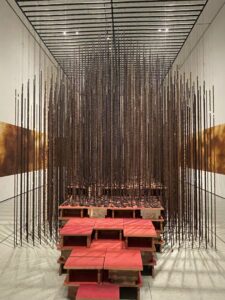
“House of Hope” by Montien Boonma

“Dial-a-poem” by John Giorno

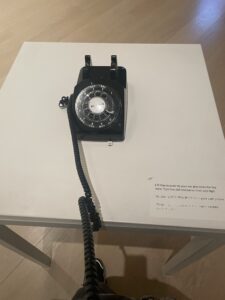
     It was also refreshing to see other pieces of art that were used to depict art other than paintings. Coming from a Chinese family that follows certain Buddhist traditions, Montien Boonma’s “House of Hope” reminded me of the very first temple I went to in China. The beads that were used for decoration reminded me of the relics the monks would put on when giving a lecture to an audience, alongside the red staircase illustrating to me happiness and prosperity just as the Chinese cultures would define the color. At the “Dial-a-poem” exhibit by John Giorno, I was able to explore auditory art by someone who gave it away to the public for free. By dialing the number the instructions asked me to, I was quick to pick up the stunning poem John Giorno had crafted within minutes about his opposition to the Vietnam War. It made me a little bit upset, especially hearing an artist reflecting upon the tragic loss of lives that were occurring from the war.

SECTION 4 (ABSTRACT ART SECTION):

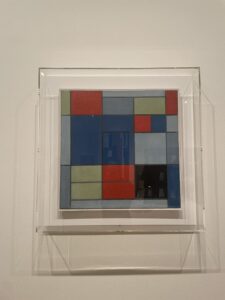
“Exhibition C” by Piet Mondrian

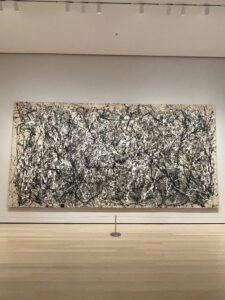
“One: Number 31, 1950” by Jackson Pollock

     The abstract art exhibit reminds me of the type of art that I’ve seen in my elementary school art room. The most notable painting my art teacher would clearly show on her wall was the “Exhibition C” painting by Piet Mondrian. To my four-year-old self at that time, nothing in the painting really stuck to me as art rather just a bunch of shapes jumbled up together. I feel like this perception was developed by seeing much more complicated portrait and landscape drawings in social media. It wasn’t until I discovered Jackson Pollock’s abstract paintings that I truly discovered the uniqueness of the drawings I would see in my elementary school art room. It was meant as a way to express one’s free mind when drawing, and how art especially is meant to communicate to the audience and doesn’t have to include any complicated details.

CONCLUSION:

     Overall, my childhood perception of trips to art museums being boring was quickly proven wrong when I visited the MOMA and discovered many hidden treasures, resulting in my perception of art to change. I saw artwork that ranged from cultural paintings, historical pieces of art, and abstract art paintings, which altogether sparked my interest in researching more about international works of art that I hadn’t learned about in school. To my surprise, I discovered that many famous paintings convey deep messages, and thus I strongly encourage whoever is reading this to venture out to the MOMA and explore other paintings rather than just paying a visit just to see the “Starry Night”.

The Whitney – Aleksey

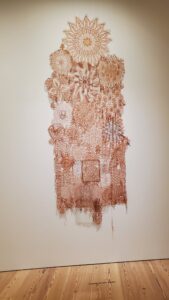
     My experience began at the entrance of the Whitney Museum, where the ticket price was free for people ages 18 or younger, which was awesome since I am 17. The building looked average, not too old, wide, long, or fancy. The Whitney only had 8 floors, 3 of which were off limits, and featured sculptures and paintings. I continued by entering the museum, where I was forced to turn in my bag and retrieve it later. The first exhibit that caught my eye was an intricate pattern, which looks like it was made out of copper wire. It is clear that this piece of art took lots of time, talent, and creativity to create. Although I believe that this does not directly represent any specific view, this artwork seems to represent various abstract flowers. This artwork also reminds me of dream catchers because of its intersecting lines that create a net. 

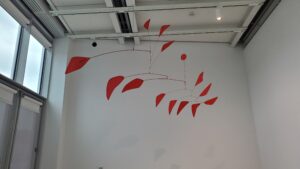
     The rest of the floor had other patterns and photos that were made out of various cottons, cloths, plastics, glass, paper, and concrete, but no artwork really popped out and seemed special, so I continued onto the 7th floor. When I stepped off the staircase, I saw a 2 meter tall rectangular shiny metal pole with a 10 by 10 centimeter base. I believe that this was a horrible piece of art because it had no complexity. It is like clay that hasn’t been molded. As I continued, I enjoyed an artwork that balanced masses on both sides of a stick because it reminded me of torque problems in physics.

     Other than that artwork, the rest of the floor had average paintings, landscapes, abstracts, and portraits, so I continued to the top floor.

     The top floor was uneventful and small. I was greeted by a coffee shop, past that there were a bunch of plants, no artwork to be seen. 

     Finally, I went to the 3rd floor, where there were three art exhibits: a video of someone painting their face completely black, an abstract piece of art, and a picture of a Native American. None of these artworks stood out to me, so I went to pick up my bag and ended my tour of the Whitney Museum.